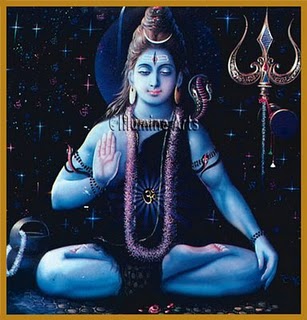
Hari bol!

"By regular attendance in classes on the Bhagavatam and by rendering of service to the pure devotee, all that is troublesome to the heart is almost completely destroyed, and loving service unto the Personality of Godhead, who is praised with transcendental songs, is established as an irrevocable fact."

Monday, March 7, 2011

**DAY 65** Canto 4, ch. 3: TALKS BETWEEN LORD SIVA AND SATI


1: Maitreya continued: In this manner the tension between the father-in-law and son-in-law, Dakṣa and Lord Śiva, continued for a considerably long period.


2: When Lord Brahmā appointed Dakṣa the chief of all the Prajāpatis, the progenitors of population, Dakṣa became very much puffed up. 3: Dakṣa began a sacrifice named vājapeya, and he became excessively confident of his support by Lord Brahmā, He then performed another great sacrifice, named bṛhaspati-sava.


4: While the sacrifice was being performed, many brahmarṣis, great sages, ancestral demigods and other demigods, their wives all very nicely decorated with ornaments, attended from different parts of the universe.
5-7: The chaste lady Satī, the daughter of Dakṣa, heard the heavenly denizens flying in the sky conversing about the great sacrifice being performed by her father. When she saw that from all directions the beautiful wives of the heavenly denizens, their eyes very beautifully glittering, were near her residence and were going to the sacrifice dressed in fine clothing and ornamented with earrings and necklaces with lockets, she approached her husband, the master of the bhūtas, in great anxiety, and spoke as follows.


8: Satī said: My dear Lord Śiva, your father-in-law is now executing great sacrifices, and all the demigods, having been invited by him, are going there. If you desire, we may also go. 9: I think that all my sisters must have gone to this great sacrificial ceremony with their husbands just to see their relatives. I also desire to decorate myself with the ornaments given to me by my father and go there with you to participate in that assemble.
10: My sisters, my mother's sisters and their husbands, and other affectionate relatives must be assembled there, so if I go I shall be able to see them, and I shall be able to see the flapping flags and the performance of the sacrifice by the great sages. For these reasons, my dear husband, I am very much anxious to go.


11: This manifested cosmos is a wonderful creation of the interaction of the three material modes, or the external energy of the Supreme Lord. This truth is fully known to you. Yet I am but a poor woman, and, as you know, I am not conversant with the truth. Therefore I wish to see my birthplace once more.


12: O never-born, O blue-throated one, not only my relatives but also other women, dressed in nice clothes and decorated with ornaments, are going there with their husbands and friends. Just see how their flocks of white airplanes have made the entire sky very beautiful. 13: O best of the demigods, how can the body of a daughter remain undisturbed when she hears that some festive event is taking place in her father's house? Even though you may be considering that I have not been invited, there is no harm if one goes to the house of one's friend, husband, spiritual master or father without invitation. 14: O immortal Śiva, please be kind towards me and fulfill my desire. You have accepted me as half of your body; therefore please show kindness towards me and accept my request.


15: The great sage Maitreya said: Lord Śiva, the deliverer of the hill Kailāsa, having thus been addressed by his dear wife, replied smilingly, although at the same time he remembered the malicious, heart-piercing speeches delivered by Dakṣa before the guardians of the universal affairs.


16: The great lord replied: My dear beautiful wife, you have said that one may go to a friend's house without being invited, and this is true, provided such a friend does not find fault with the guest because of bodily identification and thereby become angry towards him.


17: Although the six qualities education, austerity, wealth, beauty, youth and heritage are for the highly elevated, one who is proud of possessing them becomes blind, and thus he loses his good sense and cannot appreciate the glories of great personalities.


18: One should not go to anyone's house, even on the consideration of his being a relative or a friend, when the man is disturbed in his mind and looks upon the guest with raised eyebrows and angry eyes.


19: Lord Śiva continued: If one is hurt by the arrows of an enemy, one is not as aggrieved as when cut by the unkind words of a relative, for such grief continues to rend one's heart day and night.


20: My dear white-complexioned wife, it is clear that of the many daughters of Dakṣa you are the pet, yet you will not be honored at his house because of your being my wife. Rather, you will be sorry that you are connected with me.


21: One who is conducted by false ego and thus always distressed, both mentally and sensually, cannot tolerate the opulence of self-realized persons. Being unable to rise to the standard of self-realization, he envies such persons as much as demons envy the Supreme Personality of Godhead.


22: My dear young wife, certainly friends and relatives offer mutual greetings by standing up, welcoming one another and offering obeisances. But those who are elevated to the transcendental platform, being intelligent, offer such respects to the Supersoul, who is sitting within the body, not to the person who identifies with the body.


23: I am always engaged in offering obeisances to Lord Vāsudeva in pure Kṛṣṇa consciousness. Kṛṣṇa consciousness is always pure consciousness, in which the Supreme Personality of Godhead, known as Vāsudeva, is revealed without any covering.


24: Therefore you should not see your father, although he is the giver of your body, because he and his followers are envious of me. Because of his envy, O most worshipful one, he has insulted me with cruel words although I am innocent.


25: If in spite of this instruction you decide to go, neglecting my words, the future will not be good for you. You are most respectable, and when you are insulted by your relative, this insult will immediately be equal to death.


gopa's corner:

dandavat pranams. as always this chapter contains beautiful purports by Srila Prabhupada. one very interesting aspect he points out is that even though Lord Siva appears to be very strict with his wife and telling her not to go to the sacrifice, actually we know that Lord Siva is the kindness of personalities. the proof of this being when he drank poison that came out of the milk ocean when it was churned by the demigods and demons. he drank that poison for the welfare of everyone. so if he is so kind to the general populace how much more he'll be kind to his own wife. so his restrictive words are only for her benefit...and does she listen? we'll see tomorrow. ys, gopa


BlogBooster-The most productive way for mobile blogging. BlogBooster is a multi-service blog editor for iPhone, Android, WebOs and your desktop

Sunday, March 6, 2011

**DAY 64** Canto 4, ch. 2: DAKSA CURSES LORD SIVA


1: Vidura inquired: Why was Dakṣa, who was so affectionate towards his daughter, envious of Lord Śiva, who is the best among the gentle? Why did he neglect his daughter Satī?

2: Lord Śiva, the spiritual master of the entire world, is free from enmity, is a peaceful personality, and is always satisfied in himself. He is the greatest among the demigods. How is it possible that Dakṣa could be inimical towards such an auspicious personality?

3: My dear Maitreya, to part with one's life is very difficult. Would you kindly explain to me how such a son-in-law and father-in-law could quarrel so bitterly that the great goddess Satī could give up her life?

4: The sage Maitreya said: In a former time, the leaders of the universal creation performed a great sacrifice in which all the great sages, philosophers, demigods and fire-gods assembled with their followers.

5: When Dakṣa, the leader of the Prajāpatis, entered that assembly, his personal bodily luster as bright as the effulgence of the sun, the entire assembly was illuminated, and all the assembled personalities became insignificant in his presence.

6: Influenced by his personal bodily luster, all the fire-gods and other participants in that great assembly, with the exceptions of Lord Brahmā and Lord Śiva, gave up their own sitting places and stood in respect for Dakṣa.

7: Dakṣa was adequately welcomed by the president of the great assembly, Lord Brahmā. After offering Lord Brahmā respect, Dakṣa, by the order of Brahmā, properly took his seat.  8: Before taking his seat, however, Dakṣa was very much offended to see Lord Śiva sitting and not showing him any respect. At that time, Dakṣa became greatly angry, and, his eyes glowing, he began to speak very strongly against Lord Śiva.

9: All sages, brāhmaṇas and fire-gods present, please hear me with attention, for I speak about the manners of gentle persons. I do not speak out of ignorance or envy.  10: Śiva has spoiled the name and fame of the governors of the universe and has polluted the path of gentle manners. Because he is shameless, he does not know how to act.  11: He has already accepted himself as my subordinate by marrying my daughter in the presence of fire and brāhmaṇas. He has married my daughter, who is equal to Gāyatrī, and has pretended to be just like an honest person.

12: He has eyes like a monkey's, yet he has married my daughter, whose eyes are just like those of a deer cub. Nevertheless he did not stand up to receive me, nor did he think it fit to welcome me with sweet words.  13: I had no desire to give my daughter to this person, who has broken all rules of civility. Because of not observing the required rules and regulations, he is impure, but I was obliged to hand over my daughter to him just as one teaches the messages of the Vedas to a śūdra.

14-15: He lives in filthy places like crematoriums, and his companions are the ghosts and demons. Naked like a madman, sometimes laughing and sometimes crying, he smears crematorium ashes all over his body. He does not bathe regularly, and he ornaments his body with a garland of skulls and bones. Therefore only in name is he Śiva, or auspicious; actually, he is the most mad and inauspicious creature. Thus he is very dear to crazy beings in the gross mode of ignorance, and he is their leader.  16: On the request of Lord Brahmā I handed over my chaste daughter to him, although he is devoid of all cleanliness and his heart is filled with nasty things.

17: The sage Maitreya continued: Thus Dakṣa, seeing Lord Śiva sitting as if against him, washed his hands and mouth and cursed him in the following words.

18: The demigods are eligible to share in the oblations of sacrifice, but Lord Śiva, who is the lowest of all the demigods, should not have a share.

19: Maitreya continued: My dear Vidura, in spite of the requests of all the members of the sacrificial assembly, Dakṣa, in great anger, cursed Lord Śiva and then left the assembly and went back to his home.  20: Upon understanding that Lord Śiva had been cursed, Nandīśvara, one of Lord Śiva's principal associates, became greatly angry. His eyes became red, and he prepared to curse Dakṣa and all the brāhmaṇas present there who had tolerated Dakṣa's cursing Śiva in harsh words.

21: Anyone who has accepted Dakṣa as the most important personality and neglected Lord Śiva because of envy is less intelligent and, because of visualizing in duality, will be bereft of transcendental knowledge.  22: Pretentiously religious householder life, in which one is attracted to material happiness and thus also attracted to the superficial explanation of the Vedas, robs one of all intelligence and attaches one to fruitive activities as all in all.

23: Dakṣa has accepted the body as all in all. Therefore, since he has forgotten the viṣṇu-pāda, or viṣṇu-gati, and is attached to sex life only, within a short time he will have the face of a goat.

 24: Those who have become as dull as matter by cultivating materialistic education and intelligence are nesciently involved in fruitive activities. Such men have purposely insulted Lord Śiva. May they continue in the cycle of repeated birth and death.  25: May those who are envious of Lord Śiva, being attracted by the flowery language of the enchanting Vedic promises, and who have thus become dull, always remain attached to fruitive activities.

26: These brāhmaṇas take to education, austerity and vows only for the purpose of maintaining the body. They shall be devoid of discrimination between what to eat and what not to eat. They will acquire money, begging from door to door, simply for the satisfaction of the body.

27: When all the hereditary brāhmaṇas were thus cursed by Nandīśvara, the sage Bhṛgu, as a reaction, condemned the followers of Lord Śiva with this very strong brahminical curse.  28: One who takes a vow to satisfy Lord Śiva or who follows such principles will certainly become an atheist and be diverted from transcendental scriptural injunctions.

29: Those who vow to worship Lord Śiva are so foolish that they imitate him by keeping long hair on their heads. When initiated into worship of Lord Śiva, they prefer to live on wine, flesh and other such things.

30: Bhṛgu Muni continued: Since you blaspheme the Vedas and the brāhmaṇas, who are followers of the Vedic principles, it is understood that you have already taken shelter of the doctrine of atheism.  31: The Vedas give the eternal regulative principles for auspicious advancement in human civilization which have been rigidly followed in the past. The strong evidence of this principle is the Supreme Personality of Godhead, who is called Janārdana, the well-wisher of all living entities.

32: By blaspheming the principles of the Vedas, which are the pure and supreme path of the saintly persons, certainly you followers of Bhūtapati, Lord Śiva, will descend to the standard of atheism without a doubt.

33: The sage Maitreya said: When such cursing and countercursing was going on between Lord Śiva's followers and the parties of Dakṣa and Bhṛgu, Lord Śiva became very morose. Not saying anything, he left the arena of the sacrifice, followed by his disciples.

34: The sage Maitreya continued: O Vidura, all the progenitors of the universal population thus executed a sacrifice for thousands of years, for sacrifice is the best way to worship the Supreme Lord, Hari, the Personality of Godhead.

35: My dear Vidura, carrier of bows and arrows, all the demigods who were performing the sacrifice took their bath at the confluence of the Ganges and the Yamunā after completing the yajña performance. Such a bath is called avabhṛtha-snāna. After thus becoming purified in heart, they departed for their respective abodes.

gopa's corner:
dandavats.  here Daksa makes a big blunder. its called a "mad elephant" offense because  as a mad elephant can totally devastate a garden or even a whole village. and we have this tiny little bhakti-lata-bija trying to sprout. so this kind of offense practically uproots any tiny sprout of bhakti we may have cultivated.  Srila Prabhupada says in one purport that three things, lust, anger and greed must be given up if we want to progress in bhakti.  Daksa has made a great mistake. because of his offense there's cursing and counter cursing that are still in effect to this day.  and its going to get pretty wild for Daksa in the next chapters to come. Jaya Srimad Bhagavat Purana! ys, gopa

Saturday, March 5, 2011

**DAY 63 ** Canto 4, ch. 1: GENEALOGICAL TABLE OF THE DAUGHTERS OF MANU


 1: Śrī Maitreya said: Svāyambhuva Manu begot three daughters in his wife Śatarūpā, and their names were Ākūti, Devahūti and Prasūti.

2: Ākūti had two brothers, but in spite of her brothers, King Svāyambhuva Manu handed her over to Prajāpati Ruci on the condition that the son born of her be returned to Manu as his son. This he did in consultation with his wife, Śatarūpā.

3: Ruci, who was very powerful in his brahminical qualifications and was appointed one of the progenitors of the living entities, begot one son and one daughter by his wife, Ākūti.

4: Of the two children born of Ākūti, the male child was directly an incarnation of the Supreme Personality of Godhead, and His name was Yajña, which is another name of Lord Viṣṇu. The female child was a partial incarnation of Lakṣmī, the goddess of fortune, the eternal consort of Lord Viṣṇu.

5: Svāyambhuva Manu very gladly brought home the beautiful boy named Yajña, and Ruci, his son-in-law, kept with him the daughter, Dakṣiṇā.

6: The Lord of the ritualistic performance of yajña later married Dakṣiṇā, who was anxious to have the Personality of Godhead as her husband, and in this wife the Lord was also very much pleased to beget twelve children.

7: The twelve boys born of Yajña and Dakṣiṇā were named Toṣa, Pratoṣa, Santoṣa, Bhadra, Sānti, Iḍaspati, Idhma, Kavi, Vibhu, Svahna, Sudeva and Rocana.

8: During the time of Svāyambhuva Manu, these sons all became the demigods collectively named the Tuṣitas. Marīci became the head of the seven ṛṣis, and Yajña became the king of the demigods, Indra.

 9: Svāyambhuva Manu's two sons, Priyavrata and Uttānapāda, became very powerful kings, and their sons and grandsons spread all over the three worlds during that period.

10: My dear son, Svāyambhuva Manu handed over his very dear daughter Devahūti to Kardama Muni. I have already spoken to you about them, and you have heard about them almost in full.

11: Svāyambhuva Manu handed over his daughter Prasūti to the son of Brahmā named Dakṣa, who was also one of the progenitors of the living entities. The descendants of Dakṣa are spread throughout the three worlds.

12: You have already been informed about the nine daughters of Kardama Muni, who were handed over to nine different sages. I shall now describe the descendants of those nine daughters. Please hear from me.

13: Kardama Muni's daughter Kalā, who was married to Marīci, gave birth to two children, whose names were Kaśyapa and Pūrṇimā. Their descendants are spread all over the world.

14: My dear Vidura, of the two sons, Kaśyapa and Pūrṇimā, Pūrṇimā begot three children, namely Viraja, Viśvaga and Devakulyā. Of these three, Devakulyā was the water which washed the lotus feet of the Personality of Godhead and which later on transformed into the Ganges of the heavenly planets.

15: Anasūyā, the wife of Atri Muni, gave birth to three very famous sons — Soma, Dattātreya and Durvāsā — who were partial representations of Lord Viṣṇu, Lord Śiva and Lord Brahmā. Soma was a partial representation of Lord Brahmā, Dattātreya was a partial representation of Lord Viṣṇu, and Durvāsā was a partial representation of Lord Śiva.

16: After hearing this, Vidura inquired from Maitreya: My dear master, how is it that the three deities Brahmā, Viṣṇu and Śiva, who are the creator, maintainer and destroyer of the whole creation, became the offspring of the wife of Atri Muni?

17: Maitreya said: When Lord Brahmā ordered Atri Muni to create generations after marrying Anasūyā, Atri Muni and his wife went to perform severe austerities in the valley of the mountain known as Ṛkṣa.

18: In that mountain valley flows a river named Nirvindhyā. On the bank of the river are many aśoka trees and other plants full of palāśa flowers, and there is always the sweet sound of water flowing from a waterfall. The husband and wife reached that beautiful place.

19: There the great sage concentrated his mind by the yogic breathing exercises, and thereby controlling all attachment, he remained standing on one leg only, eating nothing but air, and stood there on one leg for one hundred years.

20: He was thinking: May the Lord of the universe, of whom I have taken shelter, kindly he pleased to offer me a son exactly like Him.

21: While Atri Muni was engaged in these severe austerities, a blazing fire came out of his head by virtue of his breathing exercise, and that fire was seen by the three principal deities of the three worlds.

22: At that time, the three deities approached the hermitage of Atri Muni, accompanied by the denizens of the heavenly planets, such as the celestial beauties, the Gandharvas, the Siddhas, the Vidyādharas and the Nāgas. Thus they entered the āśrama of the great sage, who had become famous by his austerities.

23: The sage was standing on one leg, but as soon as he saw that the three deities had appeared before him, he was so pleased to see them all together that despite great difficulty he approached them on one leg.

24: Thereafter he began to offer prayers to the three deities, who were seated on different carriers — a bull, a swan and Garuḍa — and who held in their hands a drum, kuśa grass and a discus. The sage offered them his respects by falling down like a stick.

25: Atri Muni was greatly pleased to see that the three devas were gracious towards him. His eyes were dazzled by the effulgence of their bodies, and therefore he closed his eyes for the time being.

26-27: But since his heart was already attracted by the deities, somehow or other he gathered his senses, and with folded hands and sweet words he began to offer prayers to the predominating deities of the universe. The great sage Atri said: O Lord Brahmā, Lord Viṣṇu and Lord Śiva, you have divided yourself into three bodies by accepting the three modes of material nature, as you do in every millennium for the creation, maintenance and dissolution of the cosmic manifestation. I offer my respectful obeisances unto all of you and beg to inquire whom of you three I have called by my prayer.

28: I called for the Supreme Personality of Godhead, desiring a son like Him, and I thought of Him only. But although He is far beyond the mental speculation of man, all three of you have come here. Kindly let me know how you have come, for I am greatly bewildered about this.

29: The great sage Maitreya continued: Upon hearing Atri Muni speak in that way, the three great deities smiled, and they replied in the following sweet words.

30: The three deities told Atri Muni: Dear brāhmaṇa, you are perfect in your determination, and therefore as you have decided, so it will happen; it will not happen otherwise. We are all the same person upon whom you were meditating, and therefore we have all come to you.

31: You will have sons who will represent a partial manifestation of our potency, and because we desire all good fortune for you, those sons will glorify your reputation throughout the world.

 32: Thus, while the couple looked on, the three deities Brahmā, Viṣṇu and Maheśvara disappeared from that place after bestowing upon Atri Muni the benediction.

33: Thereafter, from the partial representation of Brahmā, the moon-god was born of them; from the partial representation of Viṣṇu, the great mystic Dattātreya was born; and from the partial representation of Śańkara [Lord Śiva], Durvāsā was born. Now you may hear from me of the many sons of Ańgirā.

34: Ańgirā's wife, Śraddhā, gave birth to four daughters, named Sinīvālī, Kuhū, Rākā and Anumati.

35: Besides these four daughters, she also had another two sons. One of them was known as Utathya, and the other was the learned scholar Bṛhaspati.

36: Pulastya begot in his wife, Havirbhū, one son of the name Agastya, who in his next birth became Dahrāgni. Besides him, Pulastya begot another very great and saintly son, whose name was Viśravā.

37: Viśravā had two wives. The first wife was Iḍaviḍā, from whom Kuvera, the master of all Yakṣas, was born, and the next wife was named Keśinī, from whom three sons were born — Rāvaṇa, Kumbhakarṇa and Vibhīṣaṇa.

38: Gati, the wife of the sage Pulaha, gave birth to three sons, named Karmaśreṣṭha, Varīyān and Sahiṣṇu, and all of them were great sages.

39: Kratu's wife, Kriyā, gave birth to sixty thousand great sages, named the Vālakhilyas. All these sages were greatly advanced in spiritual knowledge, and their bodies were illuminated by such knowledge.

40: The great sage Vasiṣṭha begot in his wife, Ūrjā, sometimes called Arundhatī, seven spotlessly great sages, headed by the sage named Citraketu.

41: The names of these seven sages are as follows: Citraketu, Suroci, Virajā, Mitra, Ulbaṇa, Vasubhṛdyāna and Dyumān. Some other very competent sons were born from Vasiṣṭha's other wife.

42: Citti, wife of the sage Atharvā, gave birth to a son named Aśvaśirā by accepting a great vow called Dadhyañca. Now you may hear from me about the descendants of the sage Bhṛgu.

43: The sage Bhṛgu was highly fortunate. In his wife, known as Khyāti, he begot two sons, named Dhātā and Vidhātā, and one daughter, named Śrī, who was very much devoted to the Supreme Personality of Godhead.

44: The sage Meru had two daughters, named Āyati and Niyati, whom he gave in charity to Dhātā and Vidhātā. Āyati and Niyati gave birth to two sons, Mṛkaṇḍa and Prāṇa.

45: From Mṛkaṇḍa, Mārkaṇḍeya Muni was born, and from Prāṇa the sage Vedaśirā, whose son was Uśanā [Śukrācārya], also known as Kavi. Thus Kavi also belonged to the descendants of the Bhṛgu dynasty.

46-47: My dear Vidura, the population of the universe was thus increased by the descendants of these sages and the daughters of Kardama. Anyone who hears the descriptions of this dynasty with faith will be relieved from all sinful reactions. Another of Manu's daughters, known as Prasūti, married the son of Brahmā named Dakṣa.

48: Dakṣa begot sixteen very beautiful daughters with lotuslike eyes in his wife Prasūti. Of these sixteen daughters, thirteen were given in marriage to Dharma, and one daughter was given to Agni.

49-52: One of the remaining two daughters was given in charity to the Pitṛloka, where she resides very amicably, and the other was given to Lord Śiva, who is the deliverer of sinful persons from material entanglement. The names of the thirteen daughters of Dakṣa who were given to Dharma are Śraddhā, Maitrī, Dayā, Sānti, Tuṣṭi, Puṣṭi, Kriyā, Unnati, Buddhi, Medhā, Titikṣā, Hrī and Mūrti. These thirteen daughters produced the following sons: Śraddhā gave birth to Śubha, Maitrī produced Prasāda, Dayā gave birth to Abhaya, Sānti gave birth to Sukha, Tuṣṭi gave birth to Muda, Puṣṭi gave birth to Smaya, Kriyā gave birth to Yoga, Unnati gave birth to Darpa, Buddhi gave birth to Artha, Medhā gave birth to Smṛti, Titikṣā gave birth to Kṣema, and Hrī gave birth to Praśraya. Mūrti, a reservoir of all respectable qualities, gave birth to Śrī Nara-Nārāyaṇa, the Supreme Personality of Godhead.

53: On the occasion of the appearance of Nara-Nārāyaṇa, the entire world was full of joy. Everyone's mind became tranquil, and thus in all directions the air, the rivers and the mountains became pleasant.

54-55: In the heavenly planets, bands began to play, and they showered flowers from the sky. The pacified sages chanted Vedic prayers, the denizens of heaven known as the Gandharvas and Kinnaras sang, the beautiful damsels of the heavenly planets danced, and in this way, at the time of the appearance of Nara-Nārāyaṇa, all signs of good fortune were visible. Just at that time, great demigods like Brahmā also offered their respectful prayers.

56: The demigods said: Let us offer our respectful obeisances unto the transcendental Personality of Godhead, who created as His external energy this cosmic manifestation, which is situated in Him as the air and clouds are situated in space, and who has now appeared in the form of Nara-Nārāyaṇa Ṛṣi in the house of Dharma.

57: Let that Supreme Personality of Godhead, who is understood by truly authorized Vedic literature and who has created peace and prosperity to destroy all calamities of the created world, be kind enough to bestow His glance upon the demigods. His merciful glance can supersede the beauty of the spotless lotus flower which is the home of the goddess of fortune.

58: [Maitreya said:] O Vidura, thus the demigods worshiped with prayers the Supreme Personality of Godhead appearing as the sage Nara-Nārāyaṇa. The Lord glanced upon them with mercy and then departed for Gandhamādana Hill.

59: That Nara-Nārāyaṇa Ṛṣi, who is a partial expansion of Kṛṣṇa, has now appeared in the dynasties of Yadu and Kuru, in the forms of Kṛṣṇa and Arjuna respectively, to mitigate the burden of the world.

60: The predominating deity of fire begot in his wife, Svāhā, three children, named Pāvaka, Pavamāna and Śuci, who exist by eating the oblations offered to the fire of sacrifice.

61: From those three sons another forty-five descendants were generated, who are also fire-gods. The total number of fire-gods is therefore forty-nine, including the fathers and the grandfather.

62: These forty-nine fire-gods are the beneficiaries of the oblations offered in the Vedic sacrificial fire by impersonalist brāhmaṇas.

63: The Agniṣvāttas, the Barhiṣadas, the Saumyas and the Ājyapas are the Pitās. They are either sāgnika or niragnika. The wife of all these Pitās is Svadhā, who is the daughter of King Dakṣa.

64: Svadhā, who was offered to the Pitās, begot two daughters named Vayunā and Dhāriṇī, both of whom were impersonalists and were expert in transcendental and Vedic knowledge.

65: The sixteenth daughter, whose name was Satī, was the wife of Lord Śiva. She could not produce a child, although she always faithfully engaged in the service of her husband.

66: The reason is that Satī's father, Dakṣa, used to rebuke Lord Śiva in spite of Śiva's faultlessness. Consequently, before attaining a mature age, Satī gave up her body by dint of yogic mystic power.


gopa's corner:
dandavat pranams. So this is still Satya Yuga and the first created beings are populating the world. 

In Ganguli's Mahabharata many of these personalities and their strange and wonderful pastimes are described in great detail. But the Srimad Bhagavatam is pulling us onward towards the 10th canto the beautiful smiling face of the Lord.  hopefully if all goes well we will reach 10th Canto by Kartika.

did you catch the benediction in verse 46-47? pretty good deal just for reading all those names! ys, gopa


Friday, March 4, 2011

**DAY 63** Canto 3, ch. 33: ACTIVITIES OF KAPILA


 1: Śrī Maitreya said: Thus Devahūti, the mother of Lord Kapila and wife of Kardama Muni, became freed from all ignorance concerning devotional service and transcendental knowledge. She offered her obeisances unto the Lord, the author of the basic principles of the Sāńkhya system of philosophy, which is the background of liberation, and she satisfied Him with the following verses of prayer.

2: Devahūti said: Brahmā is said to be unborn because he takes birth from the lotus flower which grows from Your abdomen while You lie in the ocean at the bottom of the universe. But even Brahmā simply meditated upon You, whose body is the source of unlimited universes.

3: My dear Lord, although personally You have nothing to do, You have distributed Your energies in the interactions of the material modes of nature, and for that reason the creation, maintenance and dissolution of the cosmic manifestation take place. My dear Lord, You are self-determined and are the Supreme Personality of Godhead for all living entities. For them You created this material manifestation, and although You are one, Your diverse energies can act multifariously. This is inconceivable to us.

4: As the Supreme Personality of Godhead, You have taken birth from my abdomen. O my Lord, how is that possible for the supreme one, who has in His belly all the cosmic manifestation? The answer is that it is possible, for at the end of the millennium You lie down on a leaf of a banyan tree, and just like a small baby, You lick the toe of Your lotus foot.

5: My dear Lord, You have assumed this body in order to diminish the sinful activities of the fallen and to enrich their knowledge in devotion and liberation. Since these sinful people are dependent on Your direction, by Your own will You assume incarnations as a boar and as other forms. Similarly, You have appeared in order to distribute transcendental knowledge to Your dependents.

6: To say nothing of the spiritual advancement of persons who see the Supreme Person face to face, even a person born in a family of dog-eaters immediately becomes eligible to perform Vedic sacrifices if he once utters the holy name of the Supreme Personality of Godhead or chants about Him, hears about His pastimes, offers Him obeisances or even remembers Him.

7: Oh, how glorious are they whose tongues are chanting Your holy name! Even if born in the families of dog-eaters, such persons are worshipable. Persons who chant the holy name of Your Lordship must have executed all kinds of austerities and fire sacrifices and achieved all the good manners of the Āryans. To be chanting the holy name of Your Lordship, they must have bathed at holy places of pilgrimage, studied the Vedas and fulfilled everything required.

8: I believe, my Lord, that You are Lord Viṣṇu Himself under the name of Kapila, and You are the Supreme Personality of Godhead, the Supreme Brahman! The saints and sages, being freed from all the disturbances of the senses and mind, meditate upon You, for by Your mercy only can one become free from the clutches of the three modes of material nature. At the time of dissolution, all the Vedas are sustained in You only.

9: Thus the Supreme Personality of Godhead Kapila, satisfied by the words of His mother, towards whom He was very affectionate, replied with gravity.

10: The Personality of Godhead said: My dear mother, the path of self-realization which I have already instructed to you is very easy. You can execute this system without difficulty, and by following it you shall very soon be liberated, even within your present body.

11: My dear mother, those who are actually transcendentalists certainly follow My instructions, as I have given them to you. You may rest assured that if you traverse this path of self-realization perfectly, surely you shall be freed from fearful material contamination and shall ultimately reach Me. Mother, persons who are not conversant with this method of devotional service certainly cannot get out of the cycle of birth and death.

12: Śrī Maitreya said: The Supreme Personality of Godhead Kapila, after instructing His beloved mother, took permission from her and left His home, His mission having been fulfilled.

13: As instructed by her son, Devahūti also began to practice bhakti-yoga in that very āśrama. She practiced samādhi in the house of Kardama Muni, which was so beautifully decorated with flowers that it was considered the flower crown of the River Sarasvatī.

14: She began to bathe three times daily, and thus her curling black hair gradually became gray. Due to austerity, her body gradually became thin, and she wore old garments.

15: The home and household paraphernalia of Kardama, who was one of the Prajāpatis, was developed in such a way, by dint of his mystic powers of austerity and yoga, that his opulence was sometimes envied by those who travel in outer space in airplanes.

16: The opulence of the household of Kardama Muni is described herein. The bedsheets and mattresses were all as white as the foam of milk, the chairs and benches were made of ivory and were covered by cloths of lace with golden filigree, and the couches were made of gold and had very soft pillows.

17: The walls of the house were made of first-class marble, decorated with valuable jewels. There was no need of light, for the household was illuminated by the rays of these jewels. The female members of the household were all amply decorated with jewelry.

18: The compound of the main household was surrounded by beautiful gardens, with sweet, fragrant flowers and many trees which produced fresh fruit and were tall and beautiful. The attraction of such gardens was that singing birds would sit on the trees, and their chanting voices, as well as the humming sound of the bees, made the whole atmosphere as pleasing as possible.

19: When Devahūti would enter that lovely garden to take her bath in the pond filled with lotus flowers, the associates of the denizens of heaven, the Gandharvas, would sing about Kardama's glorious household life. Her great husband, Kardama, gave her all protection at all times.

20: Although her position was unique from all points of view, saintly Devahūti, in spite of all her possessions, which were envied even by the ladies of the heavenly planets, gave up all such comforts. She was only sorry that her great son was separated from her.

21: Devahūti's husband had already left home and accepted the renounced order of life, and then her only son, Kapila, left home. Although she knew all the truths of life and death, and although her heart was cleansed of all dirt, she was very aggrieved at the loss of her son, just as a cow is affected when her calf dies.

22: O Vidura, thus always meditating upon her son, the Supreme Personality of Godhead Kapiladeva, she very soon became unattached to her nicely decorated home.

 23: Thereafter, having heard with great eagerness and in all detail from her son, Kapiladeva, the eternally smiling Personality of Godhead, Devahūti began to meditate constantly upon the Viṣṇu form of the Supreme Lord.

24-25: She did so with serious engagement in devotional service. Because she was strong in renunciation, she accepted only the necessities of the body. She became situated in knowledge due to realization of the Absolute Truth, her heart became purified, she became fully absorbed in meditation upon the Supreme Personality of Godhead, and all misgivings due to the modes of material nature disappeared.

26: Her mind became completely engaged in the Supreme Lord, and she automatically realized the knowledge of the impersonal Brahman. As a Brahman-realized soul, she was freed from the designations of the materialistic concept of life. Thus all material pangs disappeared, and she attained transcendental bliss.

27: Situated in eternal trance and freed from illusion impelled by the modes of material nature, she forgot her material body, just as one forgets his different bodies in a dream.

28: Her body was being taken care of by the spiritual damsels created by her husband, Kardama, and since she had no mental anxiety at that time, her body did not become thin. She appeared just like a fire surrounded by smoke.

29: Because she was always absorbed in the thought of the Supreme Personality of Godhead, she was not aware that her hair was sometimes loosened or her garments were disarrayed.

30: My dear Vidura, by following the principles instructed by Kapila, Devahūti soon became liberated from material bondage, and she achieved the Supreme Personality of Godhead, as Supersoul, without difficulty.

31: The palace where Devahūti achieved her perfection, my dear Vidura, is understood to be a most sacred spot. It is known all over the three worlds as Siddhapada.

32: Dear Vidura, the material elements of her body have melted into water and are now a flowing river, which is the most sacred of all rivers. Anyone who bathes in that river also attains perfection, and therefore all persons who desire perfection go bathe there.

33: My dear Vidura, the great sage Kapila, the Personality of Godhead, left His father's hermitage with the permission of His mother and went towards the northeast.

34: While He was passing in the northern direction, all the celestial denizens known as Cāraṇas and Gandharvas, as well as the munis and the damsels of the heavenly planets, prayed and offered Him all respects. The ocean offered Him oblations and a place of residence.

35: Even now Kapila Muni is staying there in trance for the deliverance of the conditioned souls in the three worlds, and all the ācāryas, or great teachers, of the system of Sāńkhya philosophy are worshiping Him.

36: My dear son, since you have inquired from me, I have answered. O sinless one, the descriptions of Kapiladeva and His mother and their activities are the purest of all pure discourses.

37: The description of the dealings of Kapiladeva and His mother is very confidential, and anyone who hears or reads this narration becomes a devotee of the Supreme Personality of Godhead, who is carried by Garuḍa, and he thereafter enters into the abode of the Supreme Lord to engage in the transcendental loving service of the Lord.


gopa's corner:
dandavats. and that's the 3rd canto. Devahuti melted and became this river. and that place is  called Siddhapada. 

Devahuti is exemplary for all women aspiring on the path of bhakti.

Devahuti ki-jaya! Kardama Muni ki-jaya, Lord Kapila ki-jaya! 

and what a most merciful blessing is given for anyone who has heard or read this discription.  the blessings of the Bhagavatam are so powerful that they can completely change our adikara! :) ! ys, gopa


Thursday, March 3, 2011

**DAY 62** Canto 3, ch. 32: ENTANGLEMENT IN FRUITIVE ACTIVITIES


 1: The Personality of Godhead said: The person who lives in the center of household life derives material benefits by performing religious rituals, and thereby he fulfills his desire for economic development and sense gratification. Again and again he acts the same way.

2: Such persons are ever bereft of devotional service due to being too attached to sense gratification, and therefore, although they perform various kinds of sacrifices and take great vows to satisfy the demigods and forefathers, they are not interested in Kṛṣṇa consciousness, devotional service.

3: Such materialistic persons, attracted by sense gratification and devoted to the forefathers and demigods, can be elevated to the moon, where they drink an extract of the soma plant. They again return to this planet.

4: All the planets of the materialistic persons, including all the heavenly planets, such as the moon, are vanquished when the Supreme Personality of Godhead, Hari, goes to His bed of serpents, which is known as Ananta Śeṣa.

5: Those who are intelligent and are of purified consciousness are completely satisfied in Kṛṣṇa consciousness. Freed from the modes of material nature, they do not act for sense gratification; rather, since they are situated in their own occupational duties, they act as one is expected to act.

6: By executing one's occupational duties, acting with detachment and without a sense of proprietorship or false egoism, one is posted in one's constitutional position by dint of complete purification of consciousness, and by thus executing so-called material duties he can easily enter into the kingdom of God.

7: Through the path of illumination, such liberated persons approach the complete Personality of Godhead, who is the proprietor of the material and spiritual worlds and is the supreme cause of their manifestation and dissolution.

8: Worshipers of the Hiraṇyagarbha expansion of the Personality of Godhead remain within this material world until the end of two parārdhas, when Lord Brahmā also dies.

9: After experiencing the inhabitable time of the three modes of material nature, known as two parārdhas, Lord Brahmā closes the material universe, which is covered by layers of earth, water, air, fire, ether, mind, ego, etc., and goes back to Godhead.

10: The yogīs who become detached from the material world by practice of breathing exercises and control of the mind reach the planet of Brahmā, which is far, far away. After giving up their bodies, they enter into the body of Lord Brahmā, and therefore when Brahmā is liberated and goes to the Supreme Personality of Godhead, who is the Supreme Brahman, such yogīs can also enter into the kingdom of God.

11: Therefore, My dear mother, by devotional service take direct shelter of the Supreme Personality of Godhead, who is seated in everyone's heart.

12-15: My dear mother, someone may worship the Supreme Personality of Godhead with a special self-interest, but even demigods such as Lord Brahmā, great sages such as Sanat-kumāra and great munis such as Marīci have to come back to the material world again at the time of creation. When the interaction of the three modes of material nature begins, Brahmā, who is the creator of this cosmic manifestation and who is full of Vedic knowledge, and the great sages, who are the authors of the spiritual path and the yoga system, come back under the influence of the time factor. They are liberated by their nonfruitive activities and they attain the first incarnation of the puruṣa, but at the time of creation they come back in exactly the same forms and positions as they had previously.

16: Persons who are too addicted to this material world execute their prescribed duties very nicely and with great faith. They daily perform all such prescribed duties with attachment to the fruitive result.

17: Such persons, impelled by the mode of passion, are full of anxieties and always aspire for sense gratification due to uncontrolled senses. They worship the forefathers and are busy day and night improving the economic condition of their family, social or national life.

18: Such persons are called trai-vargika because they are interested in the three elevating processes. They are averse to the Supreme Personality of Godhead, who can give relief to the conditioned soul. They are not interested in the Supreme Personality's pastimes, which are worth hearing because of His transcendental prowess.

19: Such persons are condemned by the supreme order of the Lord. Because they are averse to the nectar of the activities of the Supreme Personality of Godhead, they are compared to stool-eating hogs. They give up hearing the transcendental activities of the Lord and indulge in hearing of the abominable activities of materialistic persons.

20: Such materialistic persons are allowed to go to the planet called Pitṛloka by the southern course of the sun, but they again come back to this planet and take birth in their own families, beginning again the same fruitive activities from birth to the end of life.

21: When the results of their pious activities are exhausted, they fall down by higher arrangement and again come back to this planet, just as any person raised to a high position sometimes all of a sudden falls.

22: My dear mother, I therefore advise that you take shelter of the Supreme Personality of Godhead, for His lotus feet are worth worshiping. Accept this with all devotion and love, for thus you can be situated in transcendental devotional service.

23: Engagement in Kṛṣṇa consciousness and application of devotional service unto Kṛṣṇa make it possible to advance in knowledge and detachment, as well as in self-realization.

24: The exalted devotee's mind becomes equipoised in sensory activities, and he is transcendental to that which is agreeable and not agreeable.

25: Because of his transcendental intelligence, the pure devotee is equipoised in his vision and sees himself to be uncontaminated by matter. He does not see anything as superior or inferior, and he feels himself elevated to the transcendental platform of being equal in qualities with the Supreme Person.

26: The Supreme Personality of Godhead alone is complete transcendental knowledge, but according to the different processes of understanding He appears differently, either as impersonal Brahman, as Paramātmā, as the Supreme Personality of Godhead or as the puruṣa-avatāra.

27: The greatest common understanding for all yogīs is complete detachment from matter, which can be achieved by different kinds of yoga.

28: Those who are averse to the Transcendence realize the Supreme Absolute Truth differently through speculative sense perception, and therefore, because of mistaken speculation, everything appears to them to be relative.

29: From the total energy, the mahat-tattva, I have manifested the false ego, the three modes of material nature, the five material elements, the individual consciousness, the eleven senses and the material body. Similarly, the entire universe has come from the Supreme Personality of Godhead.

30: This perfect knowledge can be achieved by a person who is already engaged in devotional service with faith, steadiness and full detachment, and who is always absorbed in thought of the Supreme. He is aloof from material association.

31: My dear respectful mother, I have already described the path of understanding the Absolute Truth, by which one can come to understand the real truth of matter and spirit and their relationship.

32: Philosophical research culminates in understanding the Supreme Personality of Godhead. After achieving this understanding, when one becomes free from the material modes of nature, he attains the stage of devotional service. Either by devotional service directly or by philosophical research, one has to find the same destination, which is the Supreme Personality of Godhead.

 33: A single object is appreciated differently by different senses due to its having different qualities. Similarly, the Supreme Personality of Godhead is one, but according to different scriptural injunctions He appears to be different.

34-36: By performing fruitive activities and sacrifices, by distributing charity, by performing austerities, by studying various literatures, by conducting philosophical research, by controlling the mind, by subduing the senses, by accepting the renounced order of life and by performing the prescribed duties of one's social order; by performing the different divisions of yoga practice, by performing devotional service and by exhibiting the process of devotional service containing the symptoms of both attachment and detachment; by understanding the science of self-realization and by developing a strong sense of detachment, one who is expert in understanding the different processes of self-realization realizes the Supreme Personality of Godhead as He is represented in the material world as well as in transcendence.

37: My dear mother, I have explained to you the process of devotional service and its identity in four different social divisions. I have explained to you as well how eternal time is chasing the living entities, although it is imperceptible to them.

38: There are varieties of material existence for the living entity according to the work he performs in ignorance or forgetfulness of his real identity. My dear mother, if anyone enters into that forgetfulness, he is unable to understand where his movements will end.

39: Lord Kapila continued: This instruction is not meant for the envious, for the agnostics or for persons who are unclean in their behavior. Nor is it for hypocrites or for persons who are proud of material possessions.

40: It is not to be instructed to persons who are too greedy and too attached to family life, nor to persons who are nondevotees and who are envious of the devotees and of the Personality of Godhead.

41: Instruction should be given to the faithful devotee who is respectful to the spiritual master, nonenvious, friendly to all kinds of living entities and eager to render service with faith and sincerity.

42: This instruction should be imparted by the spiritual master to persons who have taken the Supreme Personality of Godhead to be more dear than anything, who are not envious of anyone, who are perfectly cleansed and who have developed detachment for that which is outside the purview of Kṛṣṇa consciousness.

43: Anyone who once meditates upon Me with faith and affection, who hears and chants about Me, surely goes back home, back to Godhead.


gopa's corner:

dandavats. hmmmm. i read this chapter about 3 x's  to try to understand the gist of it.  I find it explaining something very subtle that can trip us up on our path and keep us entangled by the material shackles... 

So here's what i came up with:  one can be religious, pious, regulated, polite and clean for the purpose of enjoying life.  A person can acquire money  by giving in charity or worshiping the demigods. But to actually become disentangled from repeated birth and death ones has to do these same activities but with the secret ingredient added called bhakti.

The yoga systems are meant to detach us from the dictates of the senses. But for that operation to be successful and permanent, according to Lord Kapila, devotional service must be added. And this essential ingredient may only be received from a bonifide spiritual master. So a bhakta appears to be performing the same activities, being religious, pious, regulated, polite and clean not for his own pleasure but for Krsna's pleasure. That ability takes lots of practice but is ultimately a great gift from Sri Guru. This is the only way to become free from material bondage.

there's a very famous verse in this ch.:#23 - vasudeve bhagavati
                                                                  bhakti-yogah prayojitah
                                                                  janayaty asu vairagyam
                                                                  jnanam yad brahma-darsanam

"Engagement in Krsna consciousness and application of devotional service unto Krsna make it possible to advance in knowledge and detachment, as well as in self-realization."

tomorrow is the last ch. of 3rd Canto. :) ! ys, gopa


Wednesday, March 2, 2011

**DAY 61** Canto 3, ch. 31: LORD KAPILA'S INSTRUCTIONS ON THE MOVEMENTS OF THE LIVING ENTITIES


1: The Personality of Godhead said: Under the supervision of the Supreme Lord and according to the result of his work, the living entity, the soul, is made to enter into the womb of a woman through the particle of male semen to assume a particular type of body.

2: On the first night, the sperm and ovum mix, and on the fifth night the mixture ferments into a bubble. On the tenth night it develops into a form like a plum, and after that, it gradually turns into a lump of flesh or an egg, as the case may be.

3: In the course of a month, a head is formed, and at the end of two months the hands, feet and other limbs take shape. By the end of three months, the nails, fingers, toes, body hair, bones and skin appear, as do the organ of generation and the other apertures in the body, namely the eyes, nostrils, ears, mouth and anus.

4: Within four months from the date of conception, the seven essential ingredients of the body, namely chyle, blood, flesh, fat, bone, marrow and semen, come into existence. At the end of five months, hunger and thirst make themselves felt, and at the end of six months, the fetus, enclosed by the amnion, begins to move on the right side of the abdomen.

5: Deriving its nutrition from the food and drink taken by the mother, the fetus grows and remains in that abominable residence of stools and urine, which is the breeding place of all kinds of worms.

6: Bitten again and again all over the body by the hungry worms in the abdomen itself, the child suffers terrible agony because of his tenderness. He thus becomes unconscious moment after moment because of the terrible condition.

 7: Owing to the mother's eating bitter, pungent foodstuffs, or food which is too salty or too sour, the body of the child incessantly suffers pains which are almost intolerable.

 8: Placed within the amnion and covered outside by the intestines, the child remains lying on one side of the abdomen, his head turned towards his belly and his back and neck arched like a bow.

9: The child thus remains just like a bird in a cage, without freedom of movement. At that time, if the child is fortunate, he can remember all the troubles of his past one hundred births, and he grieves wretchedly. What is the possibility of peace of mind in that condition?

10: Thus endowed with the development of consciousness from the seventh month after his conception, the child is tossed downward by the airs that press the embryo during the weeks preceding delivery. Like the worms born of the same filthy abdominal cavity, he cannot remain in one place.

11: The living entity in this frightful condition of life, bound by seven layers of material ingredients, prays with folded hands, appealing to the Lord, who has put him in that condition.

12: The human soul says: I take shelter of the lotus feet of the Supreme Personality of Godhead, who appears in His various eternal forms and walks on the surface of the world. I take shelter of Him only, because He can give me relief from all fear and from Him I have received this condition of life, which is just befitting my impious activities.

13: I, the pure soul, appearing now bound by my activities, am lying in the womb of my mother by the arrangement of māyā. I offer my respectful obeisances unto Him who is also here with me but who is unaffected and changeless. He is unlimited, but He is perceived in the repentant heart. To Him I offer my respectful obeisances.

14: I am separated from the Supreme Lord because of my being in this material body, which is made of five elements, and therefore my qualities and senses are being misused, although I am essentially spiritual. Because the Supreme Personality of Godhead is transcendental to material nature and the living entities, because He is devoid of such a material body, and because He is always glorious in His spiritual qualities, I offer my obeisances unto Him.

15: The human soul further prays: The living entity is put under the influence of material nature and continues a hard struggle for existence on the path of repeated birth and death. This conditional life is due to his forgetfulness of his relationship with the Supreme Personality of Godhead. Therefore, without the Lord's mercy, how can he again engage in the transcendental loving service of the Lord?

16: No one other than the Supreme Personality of Godhead, as the localized Paramātmā, the partial representation of the Lord, is directing all inanimate and animate objects. He is present in the three phases of time — past, present and future. Therefore, the conditioned soul is engaged in different activities by His direction, and in order to get free from the threefold miseries of this conditional life, we have to surrender unto Him only.

17: Fallen into a pool of blood, stool and urine within the abdomen of his mother, his own body scorched by the mother's gastric fire, the embodied soul, anxious to get out, counts his months and prays, "O my Lord, when shall I, a wretched soul, be released from this confinement?"

18: My dear Lord, by Your causeless mercy I am awakened to consciousness, although I am only ten months old. For this causeless mercy of the Supreme Personality of Godhead, the friend of all fallen souls, there is no way to express my gratitude but to pray with folded hands.

19: The living entity in another type of body sees only by instinct; he knows only the agreeable and disagreeable sense perceptions of that particular body. But I have a body in which I can control my senses and can understand my destination; therefore, I offer my respectful obeisances to the Supreme Personality of Godhead, by whom I have been blessed with this body and by whose grace I can see Him within and without.

20: Therefore, my Lord, although I am living in a terrible condition, I do not wish to depart from my mother's abdomen to fall again into the blind well of materialistic life. Your external energy, called deva-māyā, at once captures the newly born child, and immediately false identification, which is the beginning of the cycle of continual birth and death, begins.

21: Therefore, without being agitated any more, I shall deliver myself from the darkness of nescience with the help of my friend, clear consciousness. Simply by keeping the lotus feet of Lord Viṣṇu in my mind, I shall be saved from entering into the wombs of many mothers for repeated birth and death.

22: Lord Kapila continued: The ten-month-old living entity has these desires even while in the womb. But while he thus extols the Lord, the wind that helps parturition propels him forth with his face turned downward so that he may be born.

23: Pushed downward all of a sudden by the wind, the child comes out with great trouble, head downward, breathless and deprived of memory due to severe agony.

24: The child thus falls on the ground, smeared with stool and blood, and plays just like a worm germinated from the stool. He loses his superior knowledge and cries under the spell of māyā.

 25: After coming out of the abdomen, the child is given to the care of persons who are unable to understand what he wants, and thus he is nursed by such persons. Unable to refuse whatever is given to him, he falls into undesirable circumstances.

26: Laid down on a foul bed infested with sweat and germs, the poor child is incapable of scratching his body to get relief from his itching sensation to say nothing of sitting up, standing or even moving.

27: In his helpless condition, gnats, mosquitoes, bugs and other germs bite the baby, whose skin is tender, just as smaller worms bite a big worm. The child, deprived of his wisdom, cries bitterly.

28: In this way, the child passes through his childhood, suffering different kinds of distress, and attains boyhood. In boyhood also he suffers pain over desires to get things he can never achieve. And thus, due to ignorance, he becomes angry and sorry.

29: With the growth of the body, the living entity, in order to vanquish his soul, increases his false prestige and anger and thereby creates enmity towards similarly lusty people.

30: By such ignorance the living entity accepts the material body, which is made of five elements, as himself. With this misunderstanding, he accepts nonpermanent things as his own and increases his ignorance in the darkest region.

31: For the sake of the body, which is a source of constant trouble to him and which follows him because he is bound by ties of ignorance and fruitive activities, he performs various actions which cause him to be subjected to repeated birth and death.

32: If, therefore, the living entity again associates with the path of unrighteousness, influenced by sensually minded people engaged in the pursuit of sexual enjoyment and the gratification of the palate, he again goes to hell as before.

33: He becomes devoid of truthfulness, cleanliness, mercy, gravity, spiritual intelligence, shyness, austerity, fame, forgiveness, control of the mind, control of the senses, fortune and all such opportunities.

34: One should not associate with a coarse fool who is bereft of the knowledge of self-realization and who is no more than a dancing dog in the hands of a woman.

35: The infatuation and bondage which accrue to a man from attachment to any other object is not as complete as that resulting from attachment to a woman or to the fellowship of men who are fond of women.

36: At the sight of his own daughter, Brahmā was bewildered by her charms and shamelessly ran up to her in the form of a stag when she took the form of a hind.

37: Amongst all kinds of living entities begotten by Brahmā, namely men, demigods and animals, none but the sage Nārāyaṇa is immune to the attraction of māyā in the form of woman.

38: Just try to understand the mighty strength of My māyā in the shape of woman, who by the mere movement of her eyebrows can keep even the greatest conquerors of the world under her grip.

39: One who aspires to reach the culmination of yoga and has realized his self by rendering service unto Me should never associate with an attractive woman, for such a woman is declared in the scripture to be the gateway to hell for the advancing devotee.

40: The woman, created by the Lord, is the representation of māyā, and one who associates with such māyā by accepting services must certainly know that this is the way of death, just like a blind well covered with grass.

41: A living entity who, as a result of attachment to a woman in his previous life, has been endowed with the form of a woman, foolishly looks upon māyā in the form of a man, her husband, as the bestower of wealth, progeny, house and other material assets.

42: A woman, therefore, should consider her husband, her house and her children to be the arrangement of the external energy of the Lord for her death, just as the sweet singing of the hunter is death for the deer.

43: Due to his particular type of body, the materialistic living entity wanders from one planet to another, following fruitive activities. In this way, he involves himself in fruitive activities and enjoys the result incessantly.

44: In this way the living entity gets a suitable body with a material mind and senses, according to his fruitive activities. When the reaction of his particular activity comes to an end, that end is called death, and when a particular type of reaction begins, that beginning is called birth.

45-46: When the eyes lose their power to see color or form due to morbid affliction of the optic nerve, the sense of sight becomes deadened. The living entity, who is the seer of both the eyes and the sight, loses his power of vision. In the same way, when the physical body, the place where perception of objects occurs, is rendered incapable of perceiving, that is known as death. When one begins to view the physical body as one's very self, that is called birth.

47: Therefore, one should not view death with horror, nor have recourse to defining the body as soul, nor give way to exaggeration in enjoying the bodily necessities of life. Realizing the true nature of the living entity, one should move about in the world free from attachment and steadfast in purpose.

48: Endowed with right vision and strengthened by devotional service and a pessimistic attitude towards material identity, one should relegate his body to this illusory world through his reason. Thus one can be unconcerned with this material world.


gopa's corner:
dandavats. this is another sobering chapter. the famous description of the child in the womb.  the description of the development of the fetus is extremely detailed and will match any modern baby book in accuracy.  this is also the famous chapter where women are described as the gateway to hell.

are you reading this, Sarasvati?

don't become disheartened. once someone asked Srila Prabhupada why there were so many negative things mentioned about women in the SB. and Srila Prabhupada answered that these discriptions were not of devotee women but of materialistic ones.
  
once Savita didi asked Sripada Madhava Maharaja why he let her do so little seva for Srila Gurudeva. Madhava M. answered that she would have to take birth as a boy. and she said, no. he would have to take birth as a girl and they would both serve Srila Gurudeva together!

the point is to stop this crazy cycle of birth and death.  Guru, sadhu and sastra are all trying to help us. sleep well don't dream of wild dogs or worms in wombs but the sweet lotus feet of Srila Gurudeva. ys, gopa


Tuesday, March 1, 2011

**DAY 60** Canto 3, Ch. 30: DISCRIPTION BY LORD KAPILA OF ADVERSE FRUITIVE ACTIVITES


1: The Personality of Godhead said: As a mass of clouds does not know the powerful influence of the wind, a person engaged in material consciousness does not know the powerful strength of the time factor, by which he is being carried.  2: Whatever is produced by the materialist with great pain and labor for so-called happiness, the Supreme Personality, as the time factor, destroys, and for this reason the conditioned soul laments.

3: The misguided materialist does not know that his very body is impermanent and that the attractions of home, land and wealth, which are in relationship to that body, are also temporary. Out of ignorance only, he thinks that everything is permanent.  4: The living entity, in whatever species of life he appears, finds a particular type of satisfaction in that species, and he is never averse to being situated in such a condition.

5: The conditioned living entity is satisfied in his own particular species of life; while deluded by the covering influence of the illusory energy, he feels little inclined to cast off his body, even when in hell, for he takes delight in hellish enjoyment.  

6: Such satisfaction with one's standard of living is due to deep-rooted attraction for body, wife, home, children, animals, wealth and friends. In such association, the conditioned soul thinks himself quite perfect.  7: Although he is always burning with anxiety, such a fool always performs all kinds of mischievous activities, with a hope which is never to be fulfilled, in order to maintain his so-called family and society.

8: He gives heart and senses to a woman, who falsely charms him with māyā. He enjoys solitary embraces and talking with her, and he is enchanted by the sweet words of the small children.  9: The attached householder remains in his family life, which is full of diplomacy and politics. Always spreading miseries and controlled by acts of sense gratification, he acts just to counteract the reactions of all his miseries, and if he can successfully counteract such miseries, he thinks that he is happy.

10: He secures money by committing violence here and there, and although he employs it in the service of his family, he himself eats only a little portion of the food thus purchased, and he goes to hell for those for whom he earned the money in such an irregular way.  11: When he suffers reverses in his occupation, he tries again and again to improve himself, but when he is baffled in all attempts and is ruined, he accepts money from others because of excessive greed.

12: Thus the unfortunate man, unsuccessful in maintaining his family members, is bereft of all beauty. He always thinks of his failure, grieving very deeply.  13: Seeing him unable to support them, his wife and others do not treat him with the same respect as before, even as miserly farmers do not accord the same treatment to their old and worn-out oxen.

14: The foolish family man does not become averse to family life although he is maintained by those whom he once maintained. Deformed by the influence of old age, he prepares himself to meet ultimate death.  15: Thus he remains at home just like a pet dog and eats whatever is so negligently given to him. Afflicted with many illnesses, such as dyspepsia and loss of appetite, he eats only very small morsels of food, and he becomes an invalid, who cannot work any more.

16: In that diseased condition, one's eyes bulge due to the pressure of air from within, and his glands become congested with mucus. He has difficulty breathing, and upon exhaling and inhaling he produces a sound like ghura-ghura, a rattling within the throat.  17: In this way he comes under the clutches of death and lies down, surrounded by lamenting friends and relatives, and although he wants to speak with them, he no longer can because he is under the control of time.

18: Thus the man, who engaged with uncontrolled senses in maintaining a family, dies in great grief, seeing his relatives crying. He dies most pathetically, in great pain and without consciousness.  19: At death, he sees the messengers of the lord of death come before him, their eyes full of wrath, and in great fear he passes stool and urine.

20: As a criminal is arrested for punishment by the constables of the state, a person engaged in criminal sense gratification is similarly arrested by the Yamadūtas, who bind him by the neck with strong rope and cover his subtle body so that he may undergo severe punishment.  21: While carried by the constables of Yamarāja, he is overwhelmed and trembles in their hands. While passing on the road he is bitten by dogs, and he can remember the sinful activities of his life. He is thus terribly distressed.

22: Under the scorching sun, the criminal has to pass through roads of hot sand with forest fires on both sides. He is whipped on the back by the constables because of his inability to walk, and he is afflicted by hunger and thirst, but unfortunately there is no drinking water, no shelter and no place for rest on the road.  23: While passing on that road to the abode of Yamarāja, he falls down in fatigue, and sometimes he becomes unconscious, but he is forced to rise again. In this way he is very quickly brought to the presence of Yamarāja.

24: Thus he has to pass ninety-nine thousand yojanas within two or three moments, and then he is at once engaged in the torturous punishment which he is destined to suffer.  25: He is placed in the midst of burning pieces of wood, and his limbs are set on fire. In some cases he is made to eat his own flesh or have it eaten by others.

26: His entrails are pulled out by the hounds and vultures of hell, even though he is still alive to see it, and he is subjected to torment by serpents, scorpions, gnats and other creatures that bite him.  27: Next his limbs are lopped off and torn asunder by elephants. He is hurled down from hilltops, and he is also held captive either in water or in a cave.

28: Men and women whose lives were built upon indulgence in illicit sex life are put into many kinds of miserable conditions in the hells known as Tāmisra, Andha-tāmisra and Raurava.

29: Lord Kapila continued: My dear mother, it is sometimes said that we experience hell or heaven on this planet, for hellish punishments are sometimes visible on this planet also.  30: After leaving this body, the man who maintained himself and his family members by sinful activities suffers a hellish life, and his relatives suffer also.

31: He goes alone to the darkest regions of hell after quitting the present body, and the money he acquired by envying other living entities is the passage money with which he leaves this world.  32: Thus, by the arrangement of the Supreme Personality of Godhead, the maintainer of kinsmen is put into a hellish condition to suffer for his sinful activities, like a man who has lost his wealth.

33: Therefore a person who is very eager to maintain his family and kinsmen simply by black methods certainly goes to the darkest region of hell, which is known as Andha-tāmisra.

34: Having gone through all the miserable, hellish conditions and having passed in a regular order through the lowest forms of animal life prior to human birth, and having thus been purged of his sins, one is reborn again as a human being on this earth.
 
gopa's corner:  
dandavats. the verses of this chapter give explicit detail to the consequences of material life as do Srila Prabhupada's purports.  the more we are absorbed in materialistic life the more these kinds of chapters in SB will scare the blank out of us. our acaryas tell us over and over again - Do not waste this human form of life. ys, gopa