Hari bol!

"By regular attendance in classes on the Bhagavatam and by rendering of service to the pure devotee, all that is troublesome to the heart is almost completely destroyed, and loving service unto the Personality of Godhead, who is praised with transcendental songs, is established as an irrevocable fact."

Wednesday, March 16, 2011

**DAY 71**Canto 4, ch. 9: DHRUVA MAHARAJA RUTURNS HOME


 1: The great sage Maitreya told Vidura: When the demigods were thus reassured by the Personality of Godhead, they were freed from all fears, and after offering their obeisances, they returned to their heavenly planets. Then the Lord, who is nondifferent from the Sahasraśīrṣā incarnation, got on the back of Garuḍa, who carried Him to the Madhuvana Forest to see His servant Dhruva.

2: The form of the Lord, which was brilliant like lightning and in which Dhruva Mahārāja, in his mature yogic process, was fully absorbed in meditation, all of a sudden disappeared. Thus Dhruva was perturbed, and his meditation broke. But as soon as he opened his eyes he saw the Supreme Personality of Godhead personally present, just as he had been seeing the Lord in his heart.

3: When Dhruva Mahārāja saw his Lord just in front of him, he was greatly agitated and offered Him obeisances and respect. He fell flat before Him like a rod and became absorbed in love of Godhead. Dhruva Mahārāja, in ecstasy, looked upon the Lord as if he were drinking the Lord with his eyes, kissing the lotus feet of the Lord with his mouth, and embracing the Lord with his arms.

4: Although Dhruva Mahārāja was a small boy, he wanted to offer prayers to the Supreme Personality of Godhead in suitable language. But because he was inexperienced, he could not adjust himself immediately. The Supreme Personality of Godhead, being situated in everyone's heart, could understand Dhruva Mahārāja's awkward position. Out of His causeless mercy He touched His conchshell to the forehead of Dhruva Mahārāja, who stood before Him with folded hands.

5: At that time Dhruva Mahārāja became perfectly aware of the Vedic conclusion and understood the Absolute Truth and His relationship with all living entities. In accordance with the line of devotional service to the Supreme Lord, whose fame is widespread, Dhruva, who in the future would receive a planet which would never be annihilated, even during the time of dissolution, offered his deliberate and conclusive prayers.

6: Dhruva Mahārāja said: My dear Lord, You are all-powerful. After entering within me, You have enlivened all my sleeping senses — my hands, legs, ears, touch sensation, life force and especially my power of speech. Let me offer my respectful obeisances unto You.

7: My Lord, You are the supreme one, but by Your different energies You appear differently in the spiritual and material worlds. You create the total energy of the material world by Your external potency, and after creation You enter within the material world as the Supersoul. You are the Supreme Person, and through the temporary modes of material nature You create varieties of manifestation, just as fire, entering into wood of different shapes, burns brilliantly in different varieties.

8: O my master, Lord Brahmā is fully surrendered unto You. In the beginning You gave him knowledge, and thus he could see and understand the entire universe, just as a person awakens from sleep and visualizes his immediate duties. You are the only shelter of all persons who desire liberation, and You are the friend of all who are distressed. How, therefore, can a learned person who has perfect knowledge ever forget You?

9: Persons who worship You simply for the sense gratification of this bag of skin are certainly influenced by Your illusory energy. In spite of having You, who are like a desire tree and are the cause of liberation from birth and death, foolish persons, such as me, desire benedictions from You for sense gratification, which is available even for those who live in hellish conditions.

10: My Lord, the transcendental bliss derived from meditating upon Your lotus feet or hearing about Your glories from pure devotees is so unlimited that it is far beyond the stage of brahmānanda, wherein one thinks himself merged in the impersonal Brahman as one with the Supreme. Since brahmānanda is also defeated by the transcendental bliss derived from devotional service, then what to speak of the temporary blissfulness of elevating oneself to the heavenly planets, which is ended by the separating sword of time? Although one may be elevated to the heavenly planets, he falls down in due course of time.

11: Dhruva Mahārāja continued: O unlimited Lord, kindly bless me so that I may associate with great devotees who engage in Your transcendental loving service constantly, as the waves of a river constantly flow. Such transcendental devotees are completely situated in an uncontaminated state of life. By the process of devotional service I shall surely be able to cross the nescient ocean of material existence, which is filled with the waves of blazing, firelike dangers. It will be very easy for me, for I am becoming mad to hear about Your transcendental qualities and pastimes, which are eternally existent.

12: O Lord who have a lotus navel, if a person happens to associate with a devotee whose heart always hankers after Your lotus feet, seeking always their fragrance, he is never attached to the material body or, in a bodily relationship, to offspring, friends, home, wealth and wife, which are very, very dear to materialistic persons. Indeed, he does not care for them.

13: My dear Lord, O Supreme Unborn, I know that the different varieties of living entities, such as animals, trees, birds, reptiles, demigods and human beings, are spread throughout the universe, which is caused by the total material energy, and I know that they are sometimes manifest and sometimes unmanifest; but I have never experienced the supreme form I behold as I see You now. Now all kinds of methods of theorizing have come to an end.

14: My dear Lord, at the end of each millennium the Supreme Personality of Godhead Garbhodakaśāyī Viṣṇu dissolves everything manifested within the universe into His belly. He lies down on the lap of Śeṣa Nāga, from His navel sprouts a golden lotus flower on a stem, and on that lotus Lord Brahmā is created. I can understand that You are the same Supreme Godhead. I therefore offer my respectful obeisances unto You.

15: My Lord, by Your unbroken transcendental glance You are the supreme witness of all stages of intellectual activities. You are eternally liberated, Your existence is situated in pure goodness, and You are existent in the Supersoul without change. You are the original Personality of Godhead, full with six opulences, and You are eternally the master of the three modes of material nature. Thus, You are always different from the ordinary living entities. As Lord Viṣṇu, You maintain all the affairs of the entire universe, and yet You stand aloof and are the enjoyer of the results of all sacrifices.

16: My dear Lord, in Your impersonal manifestation of Brahman there are always two opposing elements — knowledge and ignorance. Your multienergies are continually manifest, but the impersonal Brahman, which is undivided, original, changeless, unlimited and blissful, is the cause of the material manifestation. Because You are the same impersonal Brahman, I offer my respectful obeisances unto You.


17: My Lord, O Supreme Lord, You are the supreme personified form of all benediction. Therefore, for one who abides in Your devotional service with no other desire, worshiping Your lotus feet is better than becoming king and lording it over a kingdom. That is the benediction of worshiping Your lotus feet. To ignorant devotees like me, You are the causelessly merciful maintainer, just like a cow, who takes care of the newly born calf by supplying milk and giving it protection from attack.

18: The great sage Maitreya continued: My dear Vidura, when Dhruva Mahārāja, who had good intentions in his heart, finished his prayer, the Supreme Lord, the Personality of Godhead, who is very kind to His devotees and servants, congratulated him, speaking as follows.

19: The Personality of Godhead said: My dear Dhruva, son of the King, you have executed pious vows, and I also know the desire within your heart. Although your desire is very ambitious and very difficult to fulfill, I shall favor you with its fulfillment. All good fortune unto you.

20-21: The Supreme Personality of Godhead continued: My dear Dhruva, I shall award you the glowing planet known as the polestar, which will continue to exist even after the dissolution at the end of the millennium. No one has ever ruled this planet, which is surrounded by all the solar systems, planets and stars. All the luminaries in the sky circumambulate this planet, just as bulls tread around a central pole for the purpose of crushing grains. Keeping the polestar to their right, all the stars inhabited by the great sages like Dharma, Agni, Kaśyapa and Śukra circumambulate this planet, which continues to exist even after the dissolution of all others.

22: After your father goes to the forest and awards you the rule of his kingdom, you will rule continuously the entire world for thirty-six thousand years, and all your senses will continue to be as strong as they are now. You will never become old.

23: The Lord continued: Sometime in the future your brother, Uttama, will go hunting in the forest, and while absorbed in hunting, he will be killed. Your stepmother, Suruci, being maddened upon the death of her son, will go to search him out in the forest, but she will be devoured by a forest fire.

24: The Lord continued: I am the heart of all sacrifices. You will be able to perform many great sacrifices and also give great charities. In this way you will be able to enjoy the blessings of material happiness in this life, and at the time of your death you will be able to remember Me.

25: The Personality of Godhead continued: My dear Dhruva, after your material life in this body, you will go to My planet, which is always offered obeisances by the residents of all other planetary systems. It is situated above the planets of the seven ṛṣis, and having gone there you will never have to come back again to this material world.

26: The great sage Maitreya said: After being worshiped and honored by the boy, Dhruva Mahārāja, and after offering him His abode, Lord Viṣṇu, on the back of Garuḍa, returned to His abode, as Dhruva Mahārāja looked on.

27: Despite having achieved the desired result of his determination by worshiping the lotus feet of the Lord, Dhruva Mahārāja was not very pleased. Thus he returned to his home.

28: Śrī Vidura inquired: My dear brāhmaṇa, the abode of the Lord is very difficult to attain. It can be attained only by pure devotional service, which alone pleases the most affectionate, merciful Lord. Dhruva Mahārāja achieved this position even in one life, and he was very wise and conscientious. Why, then, was he not very pleased?

29: Maitreya answered: Dhruva Mahārāja's heart, which was pierced by the arrows of the harsh words of his stepmother, was greatly aggrieved, and thus when he fixed upon his goal of life he did not forget her misbehavior. He did not demand actual liberation from this material world, but at the end of his devotional service, when the Supreme Personality of Godhead appeared before him, he was simply ashamed of the material demands he had in his mind.

30: Dhruva Mahārāja thought to himself: To endeavor to be situated in the shade of the lotus feet of the Lord is not an ordinary task because even the great brahmacārīs headed by Sanandana, who practiced aṣṭāńga-yoga in trance, attained the shelter of the Lord's lotus feet only after many, many births. Within six months I achieved the same result, yet due to my thinking differently from the Lord, I fell down from my position.

31: Alas, just look at me! I am so unfortunate. I approached the lotus feet of the Supreme Personality of Godhead, who can immediately cut the chain of the repetition of birth and death, but still, out of my foolishness, I prayed for things which are perishable.

32: Since all the demigods who are situated in the higher planetary system will have to come down again, they are all envious of my being elevated to Vaikuṇṭhaloka by devotional service. These intolerant demigods have dissipated my intelligence, and only for this reason could I not accept the genuine benediction of the instructions of Sage Nārada.

33: Dhruva Mahārāja lamented: I was under the influence of the illusory energy; being ignorant of the actual facts, I was sleeping on her lap. Under a vision of duality, I saw my brother as my enemy, and falsely I lamented within my heart, thinking, "They are my enemies."

34: It is very difficult to satisfy the Supreme Personality of Godhead, but in my case, although I have satisfied the Supersoul of the whole universe, I have prayed only for useless things. My activities were exactly like treatment given to a person who is already dead. Just see how unfortunate I am, for in spite of meeting the Supreme Lord, who can cut one's link with birth and death, I have prayed for the same conditions again.

35: Because of my state of complete foolishness and paucity of pious activities, although the Lord offered me His personal service, I wanted material name, fame and prosperity. My case is just like that of the poor man who, when he satisfied a great emperor who wanted to give him anything he might ask, out of ignorance asked only a few broken grains of husked rice.

36: The great sage Maitreya continued: My dear Vidura, persons like you, who are pure devotees of the lotus feet of Mukunda [the Supreme Personality of Godhead, who can offer liberation] and who are always attached to the honey of His lotus feet, are always satisfied in serving at the lotus feet of the Lord. In any condition of life, such persons remain satisfied, and thus they never ask the Lord for material prosperity.

37: When King Uttānapāda heard that his son Dhruva was coming back home, as if coming back to life after death, he could not put his faith in this message, for he was doubtful of how it could happen. He considered himself the most wretched, and therefore he thought that it was not possible for him to attain such good fortune.

38: Although he could not believe the words of the messenger, he had full faith in the word of the great sage Nārada. Thus he was greatly overwhelmed by the news, and he immediately offered the messenger a highly valuable necklace in great satisfaction.

39-40: Then King Uttānapāda, being very eager to see the face of his lost son, mounted a chariot drawn by excellent horses and bedecked with golden filigree. Taking with him many learned brāhmaṇas, all the elderly personalities of his family, his officers, his ministers and his immediate friends, he immediately left the city. As he proceeded in this parade, there were auspicious sounds of conchshells, kettledrums, flutes, and the chanting of Vedic mantras to indicate all good fortune.

41: Both the queens of King Uttānapāda, namely Sunīti and Suruci, along with his other son, Uttama, appeared in the procession. The queens were seated on a palanquin.

42-43: Upon seeing Dhruva Mahārāja approaching the neighboring small forest, King Uttānapāda with great haste got down from his chariot. He had been very anxious for a long time to see his son Dhruva, and therefore with great love and affection he went forward to embrace his long-lost boy. Breathing very heavily, the King embraced him with both arms. But Dhruva Mahārāja was not the same as before; he was completely sanctified by spiritual advancement due to having been touched by the lotus feet of the Supreme Personality of Godhead.

44: Reunion with Dhruva Mahārāja fulfilled King Uttānapāda's long-cherished desire, and for this reason he smelled Dhruva's head again and again and bathed him with torrents of very cold tears.

45: Then Dhruva Mahārāja, the foremost of all nobles, first of all offered his obeisances at the feet of his father and was honored by his father with various questions. He then bowed his head at the feet of his two mothers.

46: Suruci, the younger mother of Dhruva Mahārāja, seeing that the innocent boy had fallen at her feet, immediately picked him up, embracing him with her hands, and with tears of feeling she blessed him with the words, "My dear boy, long may you live!"

47: Unto one who has transcendental qualities due to friendly behavior with the Supreme Personality of Godhead, all living entities offer honor, just as water automatically flows down by nature.

48: The two brothers Uttama and Dhruva Mahārāja also exchanged their tears. They were overwhelmed by the ecstasy of love and affection, and when they embraced one another, the hair on their bodies stood up.

49: Sunīti, the real mother of Dhruva Mahārāja, embraced the tender body of her son, who was dearer to her than her own life, and thus forgot all material grief, for she was very pleased.

50: My dear Vidura, Sunīti was the mother of a great hero. Her tears, together with the milk flowing from her breasts, wet the whole body of Dhruva Mahārāja. This was a great, auspicious sign.

51: The residents of the palace praised the Queen: Dear Queen, your beloved son was lost a long time ago, and it is your great fortune that he now has come back. It appears, therefore, that your son will be able to protect you for a very long time and will put an end to all your material pangs.

52: Dear Queen, you must have worshiped the Supreme Personality of Godhead, who delivers His devotees from the greatest danger. Persons who constantly meditate upon Him surpass the course of birth and death. This perfection is very difficult to achieve.

53: The sage Maitreya continued: My dear Vidura, when everyone was thus praising Dhruva Mahārāja, the King was very happy, and he had Dhruva and his brother seated on the back of a she-elephant. Thus he returned to his capital, where he was praised by all classes of men.

54: The whole city was decorated with columns of banana trees containing bunches of fruits and flowers, and betel nut trees with leaves and branches were seen here and there. There were also many gates set up which were structured to give the appearance of sharks.  55: At each and every gate there were burning lamps and big waterpots decorated with differently colored cloth, strings of pearls, flower garlands and hanging mango leaves.

56: In the capital city there were many palaces, city gates and surrounding walls, which were already very, very beautiful, and on this occasion all of them were decorated with golden ornaments. The domes of the city palaces glittered, as did the domes of the beautiful airplanes which hovered over the city.

57: All the quadrangles, lanes and streets in the city, and the raised sitting places at the crossings, were thoroughly cleansed and sprinkled with sandalwood water; and auspicious grains such as rice and barley, and flowers, fruits and many other auspicious presentations were scattered all over the city.  58-59: Thus as Dhruva Mahārāja passed on the road, from every place in the neighborhood all the gentle household ladies assembled to see him, and out of maternal affection they offered their blessings, showering him with white mustard seed, barley, curd, water, newly grown grass, fruits and flowers. In this way Dhruva Mahārāja, while hearing the pleasing songs sung by the ladies, entered the palace of his father.

60: Dhruva Mahārāja thereafter lived in his father's palace, which had walls bedecked with highly valuable jewels. His affectionate father took particular care of him, and he dwelled in that house just as the demigods live in their palaces in the higher planetary systems.  61: The bedding in the palace was as white as the foam of milk and was very soft. The bedsteads were made of ivory with embellishments of gold, and the chairs, benches and other sitting places and furniture were made of gold.

62: The palace of the King was surrounded by walls made of marble with many engravings made of valuable jewels like sapphires, which depicted beautiful women with shining jewel lamps in their hands.  63: The King's residence was surrounded by gardens wherein there were varieties of trees brought from the heavenly planets. In those trees there were pairs of sweetly singing birds and almost-mad bumblebees, which made a very relishable buzzing sound.   64: There were emerald staircases which led to lakes full of variously colored lotus flowers and lilies, and swans, kāraṇḍavas, cakravākas, cranes and similar other valuable birds were visible in those lakes.

65: The saintly King Uttānapāda, hearing of the glorious deeds of Dhruva Mahārāja and personally seeing also how influential and great he was, felt very satisfied, for Dhruva's activities were wonderful to the supreme degree.  66: When, after concentration, King Uttānapāda saw that Dhruva Mahārāja was suitably mature to take charge of the kingdom and that his ministers were agreeable and the citizens were also very fond of him, he enthroned Dhruva as emperor of this planet. 

67: After considering his advanced age and deliberating on the welfare of his spiritual self, King Uttānapāda detached himself from worldly affairs and entered the forest.


gopa's corner:
dandavat pranams.how sweet the Lord is. as Prsnigarbha He touches child Druva on the head with His conch shell and the boy recites such beautiful prayers! and i am praying that this mountain internet connection holds up long enough for me to post this. oh well. one day at a time! ys, gopa

Monday, March 14, 2011

**DAY 70** Canto 4, ch. 8: DHRUVA MAHARAJA LEAVES HOME FOR THE FOREST


1: The great sage Maitreya said: The four great Kumāra sages headed by Sanaka, as well as Nārada, Ṛbhu, Haḿsa, Aruṇi and Yati, all sons of Brahmā did not live at home, but became ūrdhva-retā, or naiṣṭhika-brahmacārīs, unadulterated celibates.  2: Another son of Lord Brahmā was Irreligion, whose wife's name was Falsity. From their combination were born two demons named Dambha, or Bluffing, and Māyā, or Cheating. These two demons were taken by a demon named Nirṛti, who had no children.

3: Maitreya told Vidura: O great soul, from Dambha and Māyā were born Greed and Nikṛti, or Cunning. From their combination came children named Krodha (Anger) and Hiḿsā (Envy), and from their combination were born Kali and his sister Durukti (Harsh Speech).  4: O greatest of all good men, by the combination of Kali and Harsh Speech were born children named Mṛtyu (Death) and Bhīti (Fear). From the combination of Mṛtyu and Bhīti came children named Yātanā (Excessive Pain) and Niraya (Hell).

5: My dear Vidura, I have summarily explained the causes of devastation. One who hears this description three times attains piety and washes the sinful contamination from his soul.

6: Maitreya continued: O best of the Kuru dynasty, I shall now describe before you the descendants of Svāyambhuva Manu, who was born of a part of a plenary expansion of the Supreme Personality of Godhead.
7: Svāyambhuva Manu had two sons by his wife, Śatarūpā, and the names of the sons were Uttānapāda and Priyavrata. Because both of them were descendants of a plenary expansion of Vāsudeva, the Supreme Personality of Godhead, they were very competent to rule the universe to maintain and protect the citizens.
8: King Uttānapāda had two queens, named Sunīti and Suruci. Suruci was much more dear to the King; Sunīti, who had a son named Dhruva, was not his favorite.

9: Once upon a time, King Uttānapāda was patting the son of Suruci, Uttama, placing him on his lap. Dhruva Mahārāja was also trying to get on the King's lap, but the King did not very much welcome him.  10: While the child, Dhruva Mahārāja, was trying to get on the lap of his father, Suruci, his stepmother, became very envious of the child, and with great pride she began to speak so as to be heard by the King himself.

11: Queen Suruci told Dhruva Mahārāja: My dear child, you do not deserve to sit on the throne or on the lap of the King. Surely you are also the son of the King, but because you did not take your birth from my womb, you are not qualified to sit on your father's lap.  12: My dear child, you are unaware that you were born not of my womb but of another woman. Therefore you should know that your attempt is doomed to failure. You are trying to fulfill a desire which is impossible to fulfill.  

13: If you at all desire to rise to the throne of the King, then you have to undergo severe austerities. First of all you must satisfy the Supreme Personality of Godhead, Nārāyaṇa, and then, when you are favored by Him because of such worship, you shall have to take your next birth from my womb.

14: The sage Maitreya continued: My dear Vidura, as a snake, when struck by a stick, breathes very heavily, Dhruva Mahārāja, having been struck by the strong words of his stepmother, began to breathe very heavily because of great anger. When he saw that his father was silent and did not protest, he immediately left the palace and went to his mother.

15: When Dhruva Mahārāja reached his mother, his lips were trembling in anger, and he was crying very grievously. Queen Sunīti immediately lifted her son onto her lap, while the palace residents who had heard all the harsh words of Suruci related everything in detail. Thus Sunīti also became greatly aggrieved.

16: This incident was unbearable to Sunīti's patience. She began to burn as if in a forest fire, and in her grief she became just like a burnt leaf and so lamented. As she remembered the words of her co-wife, her bright, lotuslike face filled with tears, and thus she spoke.

17: She also was breathing very heavily, and she did not know the factual remedy for the painful situation. Not finding any remedy, she said to her son: My dear son, don't wish for anything inauspicious for others. Anyone who inflicts pains upon others suffers himself from that pain.

18: Sunīti said: My dear boy, whatever has been spoken by Suruci is so, because the King, your father, does not consider me his wife or even his maidservant. He feels ashamed to accept me. Therefore it is a fact that you have taken birth from the womb of an unfortunate woman, and by being fed from her breast you have grown up.  

19: My dear boy, whatever has been spoken by Suruci, your stepmother, although very harsh to hear, is factual. Therefore, if you desire at all to sit on the same throne as your stepbrother, Uttama, then give up your envious attitude and immediately try to execute the instructions of your stepmother. Without further delay, you must engage yourself in worshiping the lotus feet of the Supreme Personality of Godhead.

20: Sunīti continued: The Supreme Personality of Godhead is so great that simply by worshiping His lotus feet, your great-grandfather, Lord Brahmā, acquired the necessary qualifications to create this universe. Although he is unborn and is the chief of all living creatures, he is situated in that exalted post because of the mercy of the Supreme Personality of Godhead, whom even great yogīs worship by controlling the mind and regulating the life air [prāṇa].

21: Sunīti informed her son: Your grandfather Svāyambhuva Manu executed great sacrifices with distribution of charity, and thereby, with unflinching faith and devotion, he worshiped and satisfied the Supreme Personality of Godhead. By acting in that way, he achieved the greatest success in material happiness and afterwards achieved liberation, which is impossible to obtain by worshiping the demigods.

22: My dear boy, you also should take shelter of the Supreme Personality of Godhead, who is very kind to His devotees. Persons seeking liberation from the cycle of birth and death always take shelter of the lotus feet of the Lord in devotional service. Becoming purified by executing your allotted occupation, just situate the Supreme Personality of Godhead in your heart, and without deviating for a moment, engage always in His service.

23: My dear Dhruva, as far as I am concerned, I do not find anyone who can mitigate your distress but the Supreme Personality of Godhead, whose eyes are like lotus petals. Many demigods such as Lord Brahmā seek the pleasure of the goddess of fortune, but the goddess of fortune herself, with a lotus flower in her hand, is always ready to render service to the Supreme Lord.

24: The great sage Maitreya continued: The instruction of Dhruva Mahārāja's mother, Sunīti, was actually meant for fulfilling his desired objective. Therefore, after deliberate consideration and with intelligence and fixed determination, he left his father's house.

25: The great sage Nārada overheard this news, and understanding all the activities of Dhruva Mahārāja, he was struck with wonder. He approached Dhruva, and touching the boy's head with his all-virtuous hand, he spoke as follows.

26: How wonderful are the powerful kṣatriyas. They cannot tolerate even a slight infringement upon their prestige. Just imagine! This boy is only a small child, yet harsh words from his stepmother proved unbearable to him.

27: The great sage Nārada told Dhruva: My dear boy, you are only a little boy whose attachment is to sports and other frivolities. Why are you so affected by words insulting your honor?  28: My dear Dhruva, if you feel that your sense of honor has been insulted, you still have no cause for dissatisfaction. This kind of dissatisfaction is another feature of the illusory energy; every living entity is controlled by his previous actions, and therefore there are different varieties of life for enjoying or suffering.

29: The process of the Supreme Personality of Godhead is very wonderful. One who is intelligent should accept that process and be satisfied with whatever comes, favorable or unfavorable, by His supreme will.

30: Now you have decided to undertake the mystic process of meditation under the instruction of your mother, just to achieve the mercy of the Lord, but in my opinion such austerities are not possible for any ordinary man. It is very difficult to satisfy the Supreme Personality of Godhead.

31: Nārada Muni continued: After trying this process for many, many births and remaining unattached to material contamination, placing themselves continually in trance and executing many types of austerities, many mystic yogīs were unable to find the end of the path of God realization.

32: For this reason, my dear boy, you should not endeavor for this; it will not be successful. It is better that you go home. When you are grown up, by the mercy of the Lord you will get a chance for these mystic performances. At that time you may execute this function.

33: One should try to keep himself satisfied in any condition of life — whether distress or happiness — which is offered by the supreme will. A person who endures in this way is able to cross over the darkness of nescience very easily.

34: Every man should act like this: when he meets a person more qualified than himself, he should be very pleased; when he meets someone less qualified than himself, he should be compassionate toward him; and when he meets someone equal to himself, he should make friendship with him. In this way one is never affected by the threefold miseries of this material world.

35: Dhruva Mahārāja said: My dear Lord Nāradajī, for a person whose heart is disturbed by the material conditions of happiness and distress, whatever you have so kindly explained for attainment of peace of mind is certainly a very good instruction. But as far as I am concerned, I am covered by ignorance, and this kind of philosophy does not touch my heart.

36: My dear lord, I am very impudent for not accepting your instructions, but this is not my fault. It is due to my having been born in a kṣatriya family. My stepmother, Suruci, has pierced my heart with her harsh words. Therefore your valuable instruction does not stand in my heart.

37: O learned brāhmaṇa, I want to occupy a position more exalted than any yet achieved within the three worlds by anyone, even by my fathers and grandfathers. If you will oblige, kindly advise me of an honest path to follow by which I can achieve the goal of my life.  38: My dear lord, you are a worthy son of Lord Brahmā, and you travel, playing on your musical instrument, the vīṇā, for the welfare of the entire universe. You are like the sun, which rotates in the universe for the benefit of all living beings.

39: The sage Maitreya continued: The great personality Nārada Muni, upon hearing the words of Dhruva Mahārāja, became very compassionate toward him, and in order to show him his causeless mercy, he gave him the following expert advice.

40: The great sage Nārada told Dhruva Mahārāja: The instruction given by your mother, Sunīti, to follow the path of devotional service to the Supreme Personality of Godhead, is just suitable for you. You should therefore completely absorb yourself in the devotional service of the Lord.

41: Any person who desires the fruits of the four principles religiosity, economic development, sense gratification and, at the end, liberation, should engage himself in the devotional service of the Supreme Personality of Godhead, for worship of His lotus feet yields the fulfillment of all of these.

42: My dear boy, I therefore wish all good fortune for you. You should go to the bank of the Yamunā, where there is a virtuous forest named Madhuvana, and there be purified. Just by going there, one draws nearer to the Supreme Personality of Godhead, who always lives there.

43: Nārada Muni instructed: My dear boy, in the waters of the Yamunā River, which is known as Kālindī, you should take three baths daily because the water is very auspicious, sacred and clear. After bathing, you should perform the necessary regulative principles for aṣṭāńga-yoga and then sit down on your āsana [sitting place] in a calm and quiet position.

44: After sitting on your seat, practice the three kinds of breathing exercises, and thus gradually control the life air, the mind and the senses. Completely free yourself from all material contamination, and with great patience begin to meditate on the Supreme Personality of Godhead.

45: [The form of the Lord is described herein.] The Lord's face is perpetually very beautiful and pleasing in attitude. To the devotees who see Him, He appears never to be displeased, and He is always prepared to award benedictions to them. His eyes, His nicely decorated eyebrows, His raised nose and His broad forehead are all very beautiful. He is more beautiful than all the demigods.

46: Nārada Muni continued: The Lord's form is always youthful. Every limb and every part of His body is properly formed, free from defect. His eyes and lips are pinkish like the rising sun. He is always prepared to give shelter to the surrendered soul, and anyone so fortunate as to look upon Him feels all satisfaction. The Lord is always worthy to be the master of the surrendered soul, for He is the ocean of mercy.

47: The Lord is further described as having the mark of Śrīvatsa, or the sitting place of the goddess of fortune, and His bodily hue is deep bluish. The Lord is a person, He wears a garland of flowers, and He is eternally manifest with four hands, which hold [beginning from the lower left hand] a conchshell, wheel, club and lotus flower.

48: The entire body of the Supreme Personality of Godhead, Vāsudeva, is decorated. He wears a valuable jeweled helmet, necklaces and bracelets, His neck is adorned with the Kaustubha jewel, and He is dressed in yellow silk garments.

49: The Lord is decorated with small golden bells around His waist, and His lotus feet are decorated with golden ankle bells. All His bodily features are very attractive and pleasing to the eyes. He is always peaceful, calm and quiet and very pleasing to the eyes and the mind.

50: Real yogīs meditate upon the transcendental form of the Lord as He stands on the whorl of the lotus of their hearts, the jewellike nails of His lotus feet glittering.

51: The Lord is always smiling, and the devotee should constantly see the Lord in this form, as He looks very mercifully toward the devotee. In this way the meditator should look toward the Supreme Personality of Godhead, the bestower of all benedictions.

52: One who meditates in this way, concentrating his mind upon the always auspicious form of the Lord, is very soon freed from all material contamination, and he does not come down from meditation upon the Lord.

53: O son of the King, now I shall speak unto you the mantra which is to be chanted with this process of meditation. One who carefully chants this mantra for seven nights can see the perfect human beings flying in the sky.

54: Oḿ namo bhagavate vāsudevāya. This is the twelve-syllable mantra for worshiping Lord Kṛṣṇa. One should install the physical forms of the Lord, and with the chanting of the mantra one should offer flowers and fruits and other varieties of foodstuffs exactly according to the rules and regulations prescribed by authorities. But this should be done in consideration of place, time, and attendant conveniences and inconveniences.

55: One should worship the Lord by offering pure water, pure flower garlands, fruits, flowers and vegetables, which are available in the forest, or by collecting newly grown grasses, small buds of flowers or even the skins of trees, and if possible, by offering tulasī leaves, which are very dear to the Supreme Personality of Godhead.

56: It is possible to worship a form of the Lord made of physical elements such as earth, water, pulp, wood and metal. In the forest one can make a form with no more than earth and water and worship Him according to the above principles. A devotee who has full control over his self should be very sober and peaceful and must be satisfied simply with eating whatever fruits and vegetables are available in the forest.

57: My dear Dhruva, besides worshiping the Deity and chanting the mantra three times a day, you should meditate upon the transcendental activities of the Supreme Personality of Godhead in His different incarnations, as exhibited by His supreme will and personal potencies.

58: One should follow in the footsteps of previous devotees regarding how to worship the Supreme Lord with the prescribed paraphernalia, or one should offer worship within the heart by reciting the mantra to the Personality of Godhead, who is nondifferent from the mantra.

59-60: Anyone who thus engages in the devotional service of the Lord, seriously and sincerely, with his mind, words and body, and who is fixed in the activities of the prescribed devotional methods, is blessed by the Lord according to his desire. If a devotee desires material religiosity, economic development, sense gratification or liberation from the material world, he is awarded these results.

61: If one is very serious about liberation, he must stick to the process of transcendental loving service, engaging twenty-four hours a day in the highest stage of ecstasy, and he must certainly be aloof from all activities of sense gratification.

62: When Dhruva Mahārāja, the son of the King, was thus advised by the great sage Nārada, he circumambulated Nārada, his spiritual master, and offered him respectful obeisances. Then he started for Madhuvana, which is always imprinted with the lotus footprints of Lord Kṛṣṇa and which is therefore especially auspicious.

63: After Dhruva entered Madhuvana Forest to execute devotional service, the great sage Nārada thought it wise to go to the King to see how he was faring within the palace. When Nārada Muni approached, the King received him properly, offering him due obeisances. After being seated comfortably, Nārada began to speak.

64: The great sage Nārada inquired: My dear King, your face appears to be withering up, and you look like you have been thinking of something for a very long time. Why is that? Have you been hampered in following your path of religious rites, economic development and sense gratification?

65: The King replied: O best of the brāhmaṇas, I am very much addicted to my wife, and I am so fallen that I have abandoned all merciful behavior, even to my son, who is only five years old. I have banished him and his mother, even though he is a great soul and a great devotee.

66: My dear brāhmaṇa, the face of my son was just like a lotus flower. I am thinking of his precarious condition. He is unprotected, and he might he very hungry. He might have lain down somewhere in the forest, and the wolves might have attacked him to eat his body.

67: Alas, just see how I was conquered by my wife! Just imagine my cruelty! Out of love and affection the boy was trying to get up on my lap, but I did not receive him, nor did I even pat him for a moment. Just imagine how hardhearted I am.

68: The great sage Nārada replied: My dear King, please do not he aggrieved about your son. He is well protected by the Supreme Personality of Godhead. Although you have no actual information of his influence, his reputation is already spread all over the world.

69: My dear King, your son is very competent. He will perform activities which would he impossible even for great kings and sages. Very soon he will complete his task and come back home. You should know that he will also spread your reputation all over the world.

70: The great Maitreya continued: The King, Uttānapāda, after being advised by Nārada Muni, practically gave up all duties in relation with his kingdom, which was very vast and wide, opulent like the goddess of fortune, and he simply began to think of his son Dhruva.

71: Elsewhere, Dhruva Mahārāja, having arrived at Madhuvana, took his bath in the River Yamunā and observed fasting in the night with great care and attention. After that, as advised by the great sage Nārada, he engaged himself in worshiping the Supreme Personality of Godhead.

72: For the first month Dhruva Mahārāja ate only fruits and berries on every third day, only to keep his body and soul together, and in this way he progressed in his worship of the Supreme Personality of Godhead.

73: In the second month Dhruva Mahārāja ate only every six days, and for his eatables he took dry grass and leaves. Thus he continued his worship.

74: In the third month he drank water only every nine days. Thus he remained completely in trance and worshiped the Supreme Personality of Godhead, who is adored by selected verses.

75: In the fourth month Dhruva Mahārāja became a complete master of the breathing exercise, and thus he inhaled air only every twelfth day. In this way he became completely fixed in his position and worshiped the Supreme Personality of Godhead.

76: By the fifth month, Mahārāja Dhruva, the son of the King, had controlled his breathing so perfectly that he was able to stand on only one leg, just as a column stands, without motion, and concentrate his mind fully on the Parabrahman.

77: He completely controlled his senses and their objects, and in this way he fixed his mind, without diversion to anything else, upon the form of the Supreme Personality of Godhead.  78: When Dhruva Mahārāja thus captured the Supreme Personality of Godhead, who is the refuge of the total material creation and who is the master of all living entities, the three worlds began to tremble.

79: As Dhruva Mahārāja, the King's son, kept himself steadily standing on one leg, the pressure of his big toe pushed down half the earth, just as an elephant being carried on a boat rocks the boat left and right with his every step.  80: When Dhruva Mahārāja became practically one in heaviness with Lord Viṣṇu, the total consciousness, due to his fully concentrating, and closing all the holes of his body, the total universal breathing became choked up, and all the great demigods in all the planetary systems felt suffocated and thus took shelter of the Supreme Personality of Godhead.

81: The demigods said: Dear Lord, You are the refuge of all moving and nonmoving living entities. We feel all living entities to be suffocating, their breathing processes choked up. We have never experienced such a thing. Since You are the ultimate shelter of all surrendered souls, we have therefore approached You; kindly save us from this danger.

82: The Supreme Personality of Godhead replied: My dear demigods, do not be perturbed by this. It is due to the severe austerity and full determination of the son of King Uttānapāda, who is now fully absorbed in thought of Me. He has obstructed the universal breathing process. You can safely return to your respective homes. I shall stop this boy in his severe acts of austerities, and you will be saved from this situation.

gopa's corner:
dandavat pranams. here is the famous pastime of Dhruva Maharaja. i have always been fascinated by why it is that Dhruva's austerity was choking the whole universe. i asked many devotees this question and the answer i found most satisfying was from one very advanced didi from Vrndavana who told me that we are all connected heart to heart because supersoul, paramatma is in each and everyone of our hearts so the austerities of Dhruva effected all hearts. similarly if one pure devotee is doing strong bhajana, his bhakti can carry the whole universe. ys, gopa

Sunday, March 13, 2011

**DAY 69** Canto 4, ch. 7: THE SACRIFICE PERFORMED BY DAKSA


1: The sage Maitreya said: O mighty-armed Vidura, Lord Śiva, being thus pacified by the words of Lord Brahmā, spoke as follows in answer to Lord Brahmā's request.

2: Lord Śiva said: My dear father, Brahmā, I do not mind the offenses created by the demigods. Because these demigods are childish and less intelligent, I do not take a serious view of their offenses, and I have punished them only in order to right them.

3: Lord Śiva continued: Since the head of Dakṣa has already been burned to ashes, he will have the head of a goat. The demigod known as Bhaga will be able to see his share of sacrifice through the eyes of Mitra.  4: The demigod Pūṣā will be able to chew only through the teeth of his disciples, and if alone, he will have to satisfy himself by eating dough made from chickpea flour. But the demigods who have agreed to give me my share of the sacrifice will recover from all their injuries.

5: Those who have had their arms cut off will have to work with the arms of Aśvinī-kumāra, and those whose hands were cut off will have to do their work with the hands of Pūṣā. The priests will also have to act in that manner. As for Bhṛgu, he will have the beard from the goat's head.  6: The great sage Maitreya said: My dear Vidura, all the personalities present were very much satisfied in heart and soul upon hearing the words of Lord Śiva, who is the best among the benedictors.

7: Thereafter, Bhṛgu, the chief of the great sages, invited Lord Śiva to come to the sacrificial arena. Thus the demigods, accompanied by the sages, Lord Śiva, and Lord Brahmā, all went to the place where the great sacrifice was being performed.  8: After everything was executed exactly as directed by Lord Śiva, Dakṣa's body was joined to the head of the animal meant to be killed in the sacrifice.

9: When the animal's head was fixed on the body of King Dakṣa, Dakṣa was immediately brought to consciousness, and as he awakened from sleep, the King saw Lord Śiva standing before him.  10: At that time, when Dakṣa saw Lord Śiva, who rides upon a bull, his heart, which was polluted by envy of Lord Śiva, was immediately cleansed, just as the water in a lake is cleansed by autumn rains.

11: King Dakṣa wanted to offer prayers to Lord Śiva, but as he remembered the ill-fated death of his daughter Satī, his eyes filled with tears, and in bereavement his voice choked up, and he could not say anything.  12: At this time, King Dakṣa, afflicted by love and affection, was very much awakened to his real senses. With great endeavor, he pacified his mind, checked his feelings, and with pure consciousness began to offer prayers to Lord Śiva.

13: King Dakṣa said: My dear Lord Śiva, I committed a great offense against you, but you are so kind that instead of withdrawing your mercy, you have done me a great favor by punishing me. You and Lord Viṣṇu never neglect even useless, unqualified brāhmaṇas. Why, then, should you neglect me, who am engaged in performing sacrifices?

14: My dear great and powerful Lord Śiva, you were created first from the mouth of Lord Brahmā in order to protect the brāhmaṇas in pursuing education, austerities, vows and self-realization. As protector of the brāhmaṇas, you always protect the regulative principles they follow, just as a cowherd boy keeps a stick in his hand to give protection to the cows.  15: I did not know your full glories. For this reason, I threw arrows of sharp words at you in the open assembly, although you did not take them into account. I was going down to hell because of my disobedience to you, who are the most respectable personality, but you took compassion upon me and saved me by awarding punishment. I request that you be pleased by your own mercy, since I cannot satisfy you by my words.

16: The great sage Maitreya said: Thus being pardoned by Lord Śiva, King Dakṣa, with the permission of Lord Brahmā, again began the performance of the yajña, along with the great learned sages, the priests and others.  17: Thereafter, in order to resume the activities of sacrifice, the brāhmaṇas first arranged to purify the sacrificial arena of the contamination caused by the touch of Vīrabhadra and the other ghostly followers of Lord Śiva. Then they arranged to offer into the fire the oblations known as puroḍāśa.

18: The great sage Maitreya said to Vidura: My dear Vidura, as soon as King Dakṣa offered the clarified butter with Yajur Veda mantras in sanctified meditation, Lord Viṣṇu appeared there in His original form as Nārāyaṇa.  19: Lord Nārāyaṇa was seated on the shoulder of Stotra, or Garuḍa, who had big wings. As soon as the Lord appeared, all directions were illuminated, diminishing the luster of Brahmā and the others present.

 20: His complexion was blackish, His garment yellow like gold, and His helmet as dazzling as the sun. His hair was bluish, the color of black bees, and His face was decorated with earrings. His eight hands held a conchshell, wheel, club, lotus flower, arrow, bow, shield and sword, and they were decorated with golden ornaments such as bangles and bracelets. His whole body resembled a blossoming tree beautifully decorated with various kinds of flowers.

21: Lord Viṣṇu looked extraordinarily beautiful because the goddess of fortune and a garland were situated on His chest. His face was beautifully decorated with a smiling attitude which can captivate the entire world, especially the devotees. Fans of white hair appeared on both sides of the Lord like white swans, and the white canopy overhead looked like the moon.

22: As soon as Lord Viṣṇu was visible, all the demigods — Lord Brahmā and Lord Śiva, the Gandharvas and all present there — immediately offered their respectful obeisances by falling down straight before Him.  23: In the presence of the glaring effulgence of the bodily luster of Nārāyaṇa, everyone else's luster faded away, and everyone stopped speaking. Fearful with awe and veneration, all present touched their hands to their heads and prepared to offer their prayers to the Supreme Personality of Godhead, Adhokṣaja.

24: Although the mental scope of even demigods like Brahmā was unable to comprehend the unlimited glories of the Supreme Lord, they were all able to perceive the transcendental form of the Supreme Personality of Godhead by His grace. Only by such grace could they offer their respectful prayers according to their different capacities.

25: When Lord Viṣṇu accepted the oblations offered in the sacrifice, Dakṣa, the Prajāpati, began with great pleasure to offer respectful prayers unto Him. The Supreme Personality of Godhead is actually the master of all sacrifices and preceptor of all the Prajāpatis, and He is served even by such personalities as Nanda and Sunanda.

26: Dakṣa addressed the Supreme Personality of Godhead: My dear Lord, You are transcendental to all speculative positions. You are completely spiritual, devoid of all fear, and You are always in control of the material energy. Even though You appear in the material energy, You are situated transcendentally. You are always free from material contamination because You are completely self-sufficient.

27: The priests addressed the Lord, saying: O Lord, transcendental to material contamination, by the curse offered by Lord Śiva's men we have become attached to fruitive activities, and thus we are now fallen and therefore do not know anything about You. On the contrary, we are now involved in the injunctions of the three departments of the Vedic knowledge under the plea of executing rituals in the name of yajña. We know that You have made arrangements for distributing the respective shares of the demigods.

28: The members of the assembly addressed the Lord: O exclusive shelter for all who are situated in troubled life, in this formidable fort of conditional existence the time element, like a snake, is always looking for an opportunity to strike. This world is full of ditches of so-called distress and happiness, and there are many ferocious animals always ready to attack. The fire of lamentation is always blazing, and the mirage of false happiness is always alluring, but one has no shelter from them. Thus foolish persons live in the cycle of birth and death, always overburdened in discharging their so-called duties, and we do not know when they will accept the shelter of Your lotus feet.

29: Lord Śiva said: My dear Lord, my mind and consciousness are always fixed on Your lotus feet, which, as the source of all benediction and the fulfillment of all desires, are worshiped by all liberated great sages because Your lotus feet are worthy of worship. With my mind fixed on Your lotus feet, I am no longer disturbed by persons who blaspheme me, claiming that my activities are not purified. I do not mind their accusations, and I excuse them out of compassion, just as You exhibit compassion toward all living entities.

30: Śrī Bhṛgu said: My dear Lord, all living entities, beginning from the highest, namely Lord Brahmā, down to the ordinary ant, are under the influence of the insurmountable spell of illusory energy, and thus they are ignorant of their constitutional position. Everyone believes in the concept of the body, and all are thus submerged in the darkness of illusion. They are actually unable to understand how You live in every living entity as the Supersoul, nor can they understand Your absolute position. But You are the eternal friend and protector of all surrendered souls. Therefore, please be kind toward us and forgive all our offenses.

31: Lord Brahmā said: My dear Lord, Your personality and eternal form cannot be understood by any person who is trying to know You through the different processes of acquiring knowledge. Your position is always transcendental to the material creation, whereas the empiric attempt to understand You is material, as are its objectives and instruments.

32: King Indra said: My dear Lord, Your transcendental form with eight hands and weapons in each of them appears for the welfare of the entire universe, and it is very pleasing to the mind and eyes. In such a form, Your Lordship is always prepared to punish the demons, who are envious of Your devotees.

33: The wives of the performers of the sacrifice said: My dear Lord, this sacrifice was arranged under the instruction of Brahmā, but unfortunately Lord Śiva, being angry at Dakṣa, devastated the entire scene, and because of his anger the animals meant for sacrifice are lying dead. Therefore the preparations of the yajña have been lost. Now, by the glance of Your lotus eyes, the sanctity of this sacrificial arena may be again invoked.

34: The sages prayed: Dear Lord, Your activities are most wonderful, and although You do everything by Your different potencies, You are not at all attached to such activities. You are not even attached to the goddess of fortune, who is worshiped by the great demigods like Brahmā, who pray to achieve her mercy.

35: The Siddhas prayed: Like an elephant that has suffered in a forest fire but can forget all its troubles by entering a river, our minds, O Lord, always merge in the nectarean river of Your transcendental pastimes, and they desire never to leave such transcendental bliss, which is as good as the pleasure of merging in the Absolute.

36: The wife of Dakṣa prayed as follows: My dear Lord, it is very fortunate that You have appeared in this arena of sacrifice. I offer my respectful obeisances unto You, and I request that You be pleased on this occasion. The sacrificial arena is not beautiful without You, just as a body is not beautiful without the head.

37: The governors of various planets spoke as follows: Dear Lord, we believe only in our direct perception, but under the circumstances we do not know whether we have actually seen You with our material senses. By our material senses we can simply perceive the cosmic manifestation, but You are beyond the five elements. You are the sixth. We see You, therefore, as a creation of the material world.

38: The great mystics said: Dear Lord, persons who see You as nondifferent from themselves, knowing that You are the Supersoul of all living entities, are certainly very, very dear to You. You are very favorable toward those who engage in devotional service, accepting You as the Lord and themselves as the servants.  39: We offer our respectful obeisances unto the Supreme, who has created varieties of manifestations and put them under the spell of the three qualities of the material world in order to create, maintain and annihilate them. He Himself is not under the control of the external energy; in His personal feature He is completely devoid of the variegated manifestation of material qualities, and He is under no illusion of false identification.

40: The personified Vedas said: We offer our respectful obeisances unto You, the Lord, the shelter of the quality of goodness and therefore the source of all religion, austerity and penance, for You are transcendental to all material qualities and no one knows You or Your actual situation.

41: The fire-god said: My dear Lord, I offer my respectful obeisances unto You because by Your favor I am as luminous as blazing fire and I accept the offerings mixed with butter and offered in sacrifice. The five kinds of offerings according to the Yajur Veda are all Your different energies, and You are worshiped by five kinds of Vedic hymns. Sacrifice means Your Supreme Personality of Godhead.

42: The demigods said: Dear Lord, formerly, when there was a devastation, You conserved all the different energies of material manifestation. At that time, all the inhabitants of the higher planets, represented by such liberated souls as Sanaka, were meditating on You by philosophical speculation. You are therefore the original person, and You rest in the water of devastation on the bed of the Śeṣa snake. Now, today, You are visible to us, who are all Your servants. Please give us protection.

43: The Gandharvas said: Dear Lord, all the demigods, including Lord Śiva, Lord Brahmā, Indra and Marīci and the great sages, are all only differentiated parts and parcels of Your body. You are the Supreme Almighty Great; the whole creation is just like a plaything for You. We always accept You as the Supreme Personality of Godhead, and we offer our respectful obeisances unto You.

44: The Vidyādharas said: Dear Lord, this human form of body is meant for attaining the highest perfectional objective, but, impelled by Your external energy, the living entity misidentifies himself with his body and with the material energy, and therefore, influenced by māyā, he wants to become happy by material enjoyment. He is misled and always attracted by temporary, illusory happiness. But Your transcendental activities are so powerful that if one engages in the hearing and chanting of such topics, he can be delivered from illusion.

45: The brāhmaṇas said: Dear Lord, You are sacrifice personified. You are the offering of clarified butter, You are the fire, You are the chanting of Vedic hymns by which the sacrifice is conducted, You are the fuel, You are the flame, You are the kuśa grass, and You are the sacrificial pots. You are the priests who perform the yajña, You are the demigods headed by Indra, and You are the sacrificial animal. Everything that is sacrificed is You or Your energy.

46: Dear Lord, O personified Vedic knowledge, in the past millennium, long, long ago, when You appeared as the great boar incarnation, You picked up the world from the water, as an elephant picks up a lotus flower from a lake. When You vibrated transcendental sound in that gigantic form of a boar, the sound was accepted as a sacrificial hymn, and great sages like Sanaka meditated upon it and offered prayers for Your glorification.

47: Dear Lord, we were awaiting Your audience because we have been unable to perform the yajñas according to the Vedic rituals. We pray unto You, therefore, to be pleased with us. Simply by chanting Your holy name, one can surpass all obstacles. We offer our respectful obeisances unto You in Your presence.

48: Śrī Maitreya said: After Lord Viṣṇu was glorified by all present, Dakṣa, his consciousness purified, arranged to begin again the yajña which had been devastated by the followers of Lord Śiva.

49: Maitreya continued: My dear sinless Vidura, Lord Viṣṇu is actually the enjoyer of the results of all sacrifices. Yet because of His being the Supersoul of all living entities, He was satisfied simply with His share of the sacrificial offerings. He therefore addressed Dakṣa in a pleasing attitude.

50: Lord Viṣṇu replied: Brahmā, Lord Śiva and I are the supreme cause of the material manifestation. I am the Supersoul, the self sufficient witness. But impersonally there is no difference between Brahmā, Lord Śiva and Me.

51: The Lord continued: My dear Dakṣa Dvija, I am the original Personality of Godhead, but in order to create, maintain and annihilate this cosmic manifestation, I act through My material energy, and according to the different grades of activity, My representations are differently named.

52: The Lord continued: One who is not in proper knowledge thinks that demigods like Brahmā and Śiva are independent, or he even thinks that the living entities are independent.  53: A person with average intelligence does not think the head and other parts of the body to be separate. Similarly, My devotee does not differentiate Viṣṇu, the all-pervading Personality of Godhead, from any thing or any living entity.

54: The Lord continued: One who does not consider Brahmā, Viṣṇu, Śiva or the living entities in general to be separate from the Supreme, and who knows Brahman, actually realizes peace; others do not.

55: The sage Maitreya said: Thus Dakṣa, the head of all Prajāpatis, having been nicely instructed by the Supreme Personality of Godhead, worshiped Lord Viṣṇu. After worshiping Him by performing the prescribed sacrificial ceremonies, Dakṣa separately worshiped Lord Brahmā and Lord Śiva.

56: With all respect, Dakṣa worshiped Lord Śiva with his share of the remnants of the yajña. After finishing the ritualistic sacrificial activities, he satisfied all the other demigods and the other people assembled there. Then, after finishing all these duties with the priests, he took a bath and was fully satisfied.

57: Thus worshiping the Supreme Lord Viṣṇu by the ritualistic performance of sacrifice, Dakṣa was completely situated on the religious path. Moreover, all the demigods who had assembled at the sacrifice blessed him that he might increase his piety, and then they left.

58: Maitreya said: I have heard that after giving up the body she had received from Dakṣa, Dākṣāyaṇī (his daughter) took her birth in the kingdom of the Himalayas. She was born as the daughter of Menā. I heard this from authoritative sources.

59: Ambikā [goddess Durgā], who was known as Dākṣāyiṇī [Satī], again accepted Lord Śiva as her husband, just as different energies of the Supreme Personality of Godhead act during the course of a new creation.

60: Maitreya said: My dear Vidura, I heard this story of the Dakṣa yajña, which was devastated by Lord Śiva, from Uddhava, a great devotee and a disciple of Bṛhaspati.

61: The great sage Maitreya concluded: If one hears and again narrates, with faith and devotion, this story of the Dakṣa yajña as it was conducted by the Supreme Personality of Godhead, Viṣṇu, then certainly one is cleared of all contamination of material existence, O son of Kuru.


gopa's corner:
dandavat pranams. what an amazing conclusion to the Daksa story. Lord Siva shows his magnanimity by giving D. the head of a goat. when the head of the goat was joined with the dead body of Daksa, he came back to life, remembered his big mistake and the death of his daughter. By Lord Siva's mercy he was repentant and offered beautiful prayers. in some beautiful purports Srila Prabhupada says that this proves that the conciousness of a living being is not necessarily in the brain but comes from the soul. this example is also in the story of King Bharata who becomes a deer but with remembrance of his previous life. Lord Siva is so kind. and there is a wonderful blessing for one who hears and narrates this pastime with faith and devotion that person will be cleared of all material contamination. SB kijaya! ys, gopa

Saturday, March 12, 2011

**DAY 68** Canto 4, ch. 6: BRAHMA SATISFIES LORD SIVA


1-2: All the priests and other members of the sacrificial assembly and all the demigods, having been defeated by the soldiers of Lord Śiva and injured by weapons like tridents and swords, approached Lord Brahmā with great fear. After offering him obeisances, they began to speak in detail of all the events which had taken place.  3: Both Lord Brahmā and Viṣṇu had already known that such events would occur in the sacrificial arena of Dakṣa, and knowing beforehand, they did not go to the sacrifice.

4: When Lord Brahmā heard everything from the demigods and the members who had attended the sacrifice, he replied: You cannot be happy in executing a sacrifice if you blaspheme a great personality and thereby offend his lotus feet. You cannot have happiness in that way.

5: You have excluded Lord Śiva from taking part in the sacrificial results, and therefore you are all offenders at his lotus feet. Still, if you go without mental reservations and surrender unto him and fall down at his lotus feet, he will be very pleased.

6: Lord Brahmā also advised them that Lord Śiva is so powerful that by his anger all the planets and their chief controllers can be destroyed immediately. Also, he said that Lord Śiva was especially sorry because he had recently lost his dear wife and was also very much afflicted by the unkind words of Dakṣa. Under the circumstances, Lord Brahmā suggested, it would behoove them to go at once and beg his pardon.  7: Lord Brahmā said that no one, not even himself, Indra, all the members assembled in the sacrificial arena, or all the sages, could know how powerful Lord Śiva is. Under the circumstances, who would dare to commit an offense at his lotus feet?.

8: After thus instructing all the demigods, the Pitās and the lords of the living entities, Lord Brahmā took them with him and left for the abode of Lord Śiva, known as the Kailāsa Hill.  9: The abode known as Kailāsa is full of different herbs and vegetables, and it is sanctified by Vedic hymns and mystic yoga practice. Thus the residents of that abode are demigods by birth and have all mystic powers. Besides them there are other human beings, who are known as Kinnaras and Gandharvas and are accompanied by their beautiful wives, who are known as Apsarās, or angels.

10: Kailāsa is full of mountains filled with all kinds of valuable jewels and minerals and surrounded by all varieties of valuable trees and plants. The top of the hill is nicely decorated by various types of deer.  11: There are many waterfalls, and in the mountains there are many beautiful caves in which the very beautiful wives of the mystics are found.

12: On Kailāsa Hill there is always the rhythmical sound of the peacocks' sweet vibrations and the bees' humming. Cuckoos are always singing, and other birds whisper amongst themselves.  13: There are tall trees with straight branches that appear to call the sweet birds, and when herds of elephants pass through the hills, it appears that the Kailāsa Hill moves with them. When the waterfalls resound, it appears that Kailāsa Hill does also.

14-15: The whole of Kailāsa Hill is decorated with various kinds of trees, of which the following names may be mentioned: mandāra, pārijāta, sarala, tamāla, tāla, kovidāra, āsana, arjuna, āmra-jāti (mango), kadamba, dhūli-kadamba, nāga, punnāga, campaka, pāṭala, aśoka, bakula, kunda and kurabaka. The entire hill is decorated with such trees, which produce flowers with fragrant aromas.  16: There are other trees also which decorate the hill, such as the golden lotus flower, the cinnamon tree, mālatī, kubja, mallikā and mādhavī.

17: Kailāsa Hill is also decorated with such trees as kata, jackfruit, julara, banyan trees, plakṣas, nyagrodhas and trees producing asafoetida. Also there are trees of betel nuts and bhūrja-patra, as well as rājapūga, blackberries and similar other trees.  18: There are mango trees, priyāla, madhuka and ińguda. Besides these there are other trees, like thin bamboos, kicaka and varieties of other bamboo trees, all decorating the tracto of Kailasa Hill.

19-20: There are different kinds of lotus flowers, such as kumuda, utpala and śatapatra. The forest appears to be a decorated garden, and the small lakes are full of various kinds of birds who whisper very sweetly. There are many kinds of other animals also, like deer, monkeys, boars, lions, ṛkṣas, śalyakas, forest cows, forest asses, tigers, small deer, buffalo and many other animals, who are fully enjoying their lives.  21: There are varieties of deer, such as karṇāntra, ekapada, aśvāsya, vṛka and kastūrī, the deer which bears musk. Besides the deer there are many banana trees which decorate the small hillside lakes very nicely.

22: There is a small lake named Alakanandā in which Satī used to take her bath, and that lake is especially auspicious. All the demigods, after seeing the specific beauty of Kailāsa Hill, were struck with wonder at the great opulence to be found there.  23: Thus the demigods saw the wonderfully beautiful region known as Alakā in the forest known as Saugandhika, which means "full of fragrance." The forest is known as Saugandhika because of its abundance of lotus flowers.

24: They also saw the two rivers named Nandā and Alakanandā. These two rivers are sanctified by the dust of the lotus feet of the Supreme Personality of Godhead, Govinda.  

25: My dear Kṣattā, Vidura, the celestial damsels come down to those rivers in their airplanes with their husbands, and after sexual enjoyment, they enter the water and enjoy sprinkling their husbands with water.

26: After the damsels of the heavenly planets bathe in the water, it becomes yellowish and fragrant due to the kuńkuma from their bodies. Thus the elephants come to bathe there with their wives, the she-elephants, and they also drink the water, although they are not thirsty.

27: The airplanes of the heavenly denizens are bedecked with pearls, gold and many valuable jewels. The heavenly denizens are compared to clouds in the sky decorated with occasional flashes of electric lightning.  28: While traveling, the demigods passed over the forest known as Saugandhika, which is full of varieties of flowers, fruits and desire trees. While passing over the forest, they also saw the regions of Yakṣeśvara.

29: In that celestial forest there were many birds whose necks were colored reddish and whose sweet sounds mixed with the humming of the bees. The lakes were abundantly decorated with crying swans as well as strong-stemmed lotus flowers.

30: All these atmospheric influences unsettled the forest elephants who flocked together in the sandalwood forest, and the blowing wind agitated the minds of the damsels there for further sexual enjoyment.  31: They also saw that the bathing ghāṭas and their staircases were made of vaidūrya-maṇi. The water was full of lotus flowers. Passing by such lakes, the demigods reached a place where there was a great banyan tree.

32: That banyan tree was eight hundred miles high, and its branches spread over six hundred miles around. The tree cast a fine shade which permanently cooled the temperature, yet there was no noise of birds.  33: The demigods saw Lord Śiva sitting under that tree, which was competent to give perfection to mystic yogīs and deliver all people. As grave as time eternal, he appeared to have given up all anger.

34: Lord Śiva sat there, surrounded by saintly persons like Kuvera, the master of the Guhyakas, and the four Kumāras, who were already liberated souls. Lord Śiva was grave and saintly.  35: The demigods saw Lord Śiva situated in his perfection as the master of the senses, knowledge, fruitive activities and the path of achieving perfection. He was the friend of the entire world, and by virtue of his full affection for everyone, he was very auspicious.

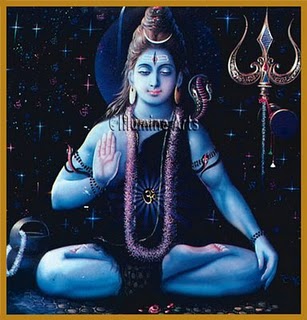
36: He was seated on a deerskin and was practicing all forms of austerity. Because his body was smeared with ashes, he looked like an evening cloud. On his hair was the sign of a half-moon, a symbolic representation.  37: He was seated on a straw mattress and speaking to all present, including the great sage Nārada, to whom he specifically spoke about the Absolute Truth.

38: His left leg was placed on his right thigh, and his left hand was placed on his left thigh. In his right hand he held rudrākṣa beads. This sitting posture is called vīrāsana. He sat in the vīrāsana posture, and his finger was in the mode of argument.  39: All the sages and demigods, headed by Indra, offered their respectful obeisances unto Lord Śiva with folded hands. Lord Śiva was dressed in saffron garments and absorbed in trance, thus appearing to be the foremost of all sages.

40: Lord Śiva's lotus feet were worshiped by both the demigods and demons, but still, in spite of his exalted position, as soon as he saw that Lord Brahmā was there among all the other demigods, he immediately stood up and offered him respect by bowing down and touching his lotus feet, just as Vāmanadeva offered His respectful obeisances to Kaśyapa Muni.

41: All the sages who were sitting with Lord Śiva, such as Nārada and others, also offered their respectful obeisances to Lord Brahmā. After being so worshiped, Lord Brahmā, smiling, began to speak to Lord Śiva.

42: Lord Brahmā said: My dear Lord Śiva, I know that you are the controller of the entire material manifestation, the combination father and mother of the cosmic manifestation, and the Supreme Brahman beyond the cosmic manifestation as well. I know you in that way.

43: My dear lord, you create this cosmic manifestation, maintain it, and annihilate it by expansion of your personality, exactly as a spider creates, maintains and winds up its web.

44: My dear lord, Your Lordship has introduced the system of sacrifices through the agency of Dakṣa, and thus one may derive the benefits of religious activities and economic development. Under your regulative principles, the institution of the four varṇas and āśramas is respected. The brāhmaṇas therefore vow to follow this system strictly.

45: O most auspicious lord, you have ordained the heavenly planets, the spiritual Vaikuṇṭha planets and the impersonal Brahman sphere as the respective destinations of the performers of auspicious activities. Similarly, for others, who are miscreants, you have destined different kinds of hells which are horrible and ghastly. Yet sometimes it is found that their destinations are just the opposite. It is very difficult to ascertain the cause of this.

46: My dear Lord, devotees who have fully dedicated their lives unto your lotus feet certainly observe your presence as Paramātmā in each and every being, and as such they do not differentiate between one living being and another. Such persons treat all living entities equally. They never become overwhelmed by anger like animals, who can see nothing without differentiation.

47: Persons who observe everything with differentiation, who are simply attached to fruitive activities, who are mean minded, who are always pained to see the flourishing condition of others and who thus give distress to them by uttering harsh and piercing words have already been killed by providence. Thus there is no need for them to be killed again by an exalted personality like you.

48: My dear lord, if in some places materialists, who are already bewildered by the insurmountable illusory energy of the Supreme Godhead, sometimes commit offenses, a saintly person, with compassion, does not take this seriously. Knowing that they commit offenses because they are overpowered by the illusory energy, he does not show his prowess to counteract them.

49: My dear lord, you are never bewildered by the formidable influence of the illusory energy of the Supreme Personality of Godhead. Therefore you are omniscient and should be merciful and compassionate toward those who are bewildered by the same illusory energy and are very much attached to fruitive activities.

50: My dear Lord Śiva, you are a shareholder of a portion of the sacrifice, and you are the giver of the result. The bad priests did not deliver your share, and therefore you destroyed everything, and the sacrifice remains unfinished. Now you can do the needful and take your rightful share.

51: My dear lord, by your mercy the performer of the sacrifice (King Dakṣa) may get back his life, Bhaga may get back his eyes, Bhṛgu his mustache, and Pūṣā his teeth.  52: O Lord Śiva, may the demigods and the priests whose limbs have been broken by your soldiers recover from the injuries by your grace.  

53: O destroyer of the sacrifice, please take your portion of the sacrifice and let the sacrifice be completed by your grace.

gopa's corner:
dandavat pranams. i think this is the most beautiful description of Lord Siva ever! what a magnanimous personality! ys, gopa

Friday, March 11, 2011

**DAY 67** Canto 4, Ch. 5: FRUSTRATION OF THE SACRIFICE OF DAKSA


SB 4.5.1: Maitreya said: When Lord Śiva heard from Nārada that Satī, his wife, was now dead because of Prajāpati Dakṣa's insult to her and that his soldiers had been driven away by the Ṛbhu demigods, he became greatly angry.

SB 4.5.2: Thus Lord Śiva, being extremely angry, pressed his lips with his teeth and immediately snatched from his head a strand of hair which blazed like electricity or fire. He stood up at once, laughing like a madman, and dashed the hair to the ground.

SB 4.5.3: A fearful black demon as high as the sky and as bright as three suns combined was thereby created, his teeth very fearful and the hairs on his head like burning fire. He had thousands of arms, equipped with various weapons, and he was garlanded with the heads of men.

SB 4.5.4: When that gigantic demon asked with folded hands, "What shall I do, my lord?" Lord Śiva, who is known as Bhūtanātha, directly ordered, "Because you are born from my body, you are the chief of all my associates. Therefore, kill Dakṣa and his soldiers at the sacrifice."

SB 4.5.5: Maitreya continued: My dear Vidura, that black person was the personified anger of the Supreme Personality of Godhead, and he was prepared to execute the orders of Lord Śiva. Thus, considering himself capable of coping with any power offered against him, he circumambulated Lord Śiva.

SB 4.5.6: Many other soldiers of Lord Śiva followed the fierce personality in a tumultuous uproar. He carried a great trident, fearful enough to kill even death, and on his legs he wore bangles which seemed to roar.

SB 4.5.7: At that time, all the persons assembled in the sacrificial arena — the priests, the chief of the sacrificial performance, and the brāhmaṇas and their wives — wondered where the darkness was coming from. Later they could understand that it was a dust storm, and all of them were full of anxiety.

SB 4.5.8: Conjecturing on the origin of the storm, they said: There is no wind blowing, and no cows are passing, nor is it possible that this dust storm could be raised by plunderers, for there is still the strong King Barhi, who would punish them. Where is this dust storm blowing from? Is the dissolution of the planet now to occur?

SB 4.5.9: Prasūti, the wife of Dakṣa, along with the other women assembled, became very anxious and said: This danger has been created by Dakṣa because of the death of Satī, who, even though completely innocent, quit her body as her sisters looked on.

SB 4.5.10: At the time of dissolution, Lord Śiva's hair is scattered, and he pierces the rulers of the different directions with his trident. He laughs and dances proudly, scattering their hands like flags, as thunder scatters the clouds all over the world.

SB 4.5.11: The gigantic black man bared his fearful teeth. By the movements of his brows he scattered the luminaries all over the sky, and he covered them with his strong, piercing effulgence. Because of the misbehavior of Dakṣa, even Lord Brahmā, Dakṣa's father, could not have been saved from the great exhibition of anger.

SB 4.5.12: While all the people talked amongst themselves, Dakṣa saw dangerous omens from all sides, from the earth and from the sky.

SB 4.5.13: My dear Vidura, all the followers of Lord Śiva surrounded the arena of sacrifice. They were of short stature and were equipped with various kinds of weapons; their bodies appeared to be like those of sharks, blackish and yellowish. They ran all around the sacrificial arena and thus began to create disturbances.

SB 4.5.14: Some of the soldiers pulled down the pillars which were supporting the pandal of sacrifice, some of them entered the female quarters, some began destroying the sacrificial arena, and some entered the kitchen and the residential quarters.

SB 4.5.15: They broke all the pots made for use in the sacrifice, and some of them began to extinguish the sacrificial fire. Some tore down the boundary line of the sacrificial arena, and some passed urine on the arena.

SB 4.5.16: Some blocked the way of the fleeing sages, some threatened the women assembled there, and some arrested the demigods who were fleeing the pandal.

SB 4.5.17: Maṇimān, one of the followers of Lord Śiva, arrested Bhṛgu Muni, and Vīrabhadra, the black demon, arrested Prajāpati Dakṣa. Another follower, who was named Caṇḍeśa, arrested Pūṣā. Nandīśvara arrested the demigod Bhaga.

SB 4.5.18: There was a continuous shower of stones, and all the priests and other members assembled at the sacrifice were put into immense misery. For fear of their lives, they dispersed in different directions.

SB 4.5.19: Vīrabhadra tore off the mustache of Bhṛgu, who was offering the sacrificial oblations with his hands in the fire.

SB 4.5.20: Vīrabhadra immediately caught Bhaga, who had been moving his eyebrows during Bhṛgu's cursing of Lord Śiva, and out of great anger thrust him to the ground and forcibly put out his eyes.

SB 4.5.21: Just as Baladeva knocked out the teeth of Dantavakra, the King of Kalińga, during the gambling match at the marriage ceremony of Aniruddha, Vīrabhadra knocked out the teeth of both Dakṣa, who had shown them while cursing Lord Śiva, and Pūṣā, who by smiling sympathetically had also shown his teeth.

SB 4.5.22: Then Vīrabhadra, the giantlike personality, sat on the chest of Dakṣa and tried to separate his head from his body with sharp weapons, but was unsuccessful.

SB 4.5.23: He tried to cut the head of Dakṣa with hymns as well as weapons, but still it was hard to cut even the surface of the skin of Dakṣa's head. Thus Vīrabhadra was exceedingly bewildered.

SB 4.5.24: Then Vīrabhadra saw the wooden device in the sacrificial arena by which the animals were to have been killed. He took the opportunity of this facility to behead Dakṣa.

SB 4.5.25: Upon seeing the action of Vīrabhadra, the party of Lord Śiva was pleased and cried out joyfully, and all the bhūtas, ghosts and demons that had come made a tumultuous sound. On the other hand, the brāhmaṇas in charge of the sacrifice cried out in grief at the death of Dakṣa.

SB 4.5.26: Vīrabhadra then took the head and with great anger threw it into the southern side of the sacrificial fire, offering it as an oblation. In this way the followers of Lord Śiva devastated all the arrangements for sacrifice. After setting fire to the whole arena, they departed for their master's abode, Kailāsa.
 gopa's corner:
dandavat pranams. ahh, what an amazing chapter. when offense is made to such an exalted soul all havoc breaks out. i'm a bit freaked out presently because my internet connection is not working. but as i get little windows of online time i'll see what i can blog. i'm having so much fun doing this but i'm not going to stress about the technology. if Krsna wants He can make all arrangements. so i'll catch up to our year's schedule when i get a chance. ys, gopa

Wednesday, March 9, 2011

**DAY 66** Canto 4, ch. 4: SATI QUITS HER BODY

SB 4.4.1: The sage Maitreya said: Lord Śiva was silent after speaking to Satī, seeing her between decisions. Satī was very much anxious to see her relatives at her father's house, but at the same time she was afraid of Lord Śiva's warning. Her mind unsettled, she moved in and out of the room as a swing moves this way and that.

SB 4.4.2: Satī felt very sorry at being forbidden to go see her relatives at her father's house, and due to affection for them, tears fell from her eyes. Shaking and very much afflicted, she looked at her uncommon husband, Lord Śiva, as if she were going to blast him with her vision.

SB 4.4.3: Thereafter Satī left her husband, Lord Śiva, who had given her half his body due to affection. Breathing very heavily because of anger and bereavement, she went to the house of her father. This less intelligent act was due to her being a weak woman.

SB 4.4.4: When they saw Satī leaving alone very rapidly, thousands of Lord Śiva's disciples, headed by Maṇimān and Mada, quickly followed her with his bull Nandī in front and accompanied by the Yakṣas.

SB 4.4.5: The disciples of Lord Śiva arranged for Satī to be seated on the back of a bull and gave her the bird which was her pet. They bore a lotus flower, a mirror and all such paraphernalia for her enjoyment and covered her with a great canopy. Followed by a singing party with drums, conchshells and bugles, the entire procession was as pompous as a royal parade.

SB 4.4.6: She then reached her father's house, where the sacrifice was being performed, and entered the arena where everyone was chanting the Vedic hymns. The great sages, brāhmaṇas and demigods were all assembled there, and there were many sacrificial animals, as well as pots made of clay, stone, gold, grass and skin, which were all requisite for the sacrifice.

SB 4.4.7: When Satī, with her followers, reached the arena, because all the people assembled were afraid of Dakṣa, none of them received her well. No one welcomed her but her mother and sisters, who, with tears in their eyes and with glad faces, welcomed her and talked with her very pleasingly.

SB 4.4.8: Although she was received by her sisters and mother, she did not reply to their words of reception, and although she was offered a seat and presents, she did not accept anything, for her father neither talked with her nor welcomed her by asking about her welfare.

SB 4.4.9: Present in the arena of sacrifice, Satī saw that there were no oblations for her husband, Lord Śiva. Next she realized that not only had her father failed to invite Lord Śiva, but when he saw Lord Śiva's exalted wife, Dakṣa did not receive her either. Thus she became greatly angry, so much so that she looked at her father as if she were going to burn him with her eyes.

SB 4.4.10: The followers of Lord Śiva, the ghosts, were ready to injure or kill Dakṣa, but Satī stopped them by her order. She was very angry and sorrowful, and in that mood she began to condemn the process of sacrificial fruitive activities and persons who are very proud of such unnecessary and troublesome sacrifices. She especially condemned her father, speaking against him in the presence of all.

SB 4.4.11: The blessed goddess said: Lord Śiva is the most beloved of all living entities. He has no rival. No one is very dear to him, and no one is his enemy. No one but you could be envious of such a universal being, who is free from all enmity.

SB 4.4.12: Twice-born Dakṣa, a man like you can simply find fault in the qualities of others. Lord Śiva, however, not only finds no faults with others' qualities, but if someone has a little good quality, he magnifies it greatly. Unfortunately, you have found fault with such a great soul.

SB 4.4.13: It is not wonderful for persons who have accepted the transient material body as the self to engage always in deriding great souls. Such envy on the part of materialistic persons is very good because that is the way they fall down. They are diminished by the dust of the feet of great personalities.

SB 4.4.14: Satī continued: My dear father, you are committing the greatest offense by envying Lord Śiva, whose very name, consisting of two syllables, śi and va, purifies one of all sinful activities. His order is never neglected. Lord Śiva is always pure, and no one but you envies him.

SB 4.4.15: You are envious of Lord Śiva, who is the friend of all living entities within the three worlds. For the common man he fulfills all desires, and because of their engagement in thinking of his lotus feet, he also blesses higher personalities who are seeking after brahmānanda [transcendental bliss].

SB 4.4.16: Do you think that greater, more respectable personalities than you, such as Lord Brahmā, do not know this inauspicious person who goes under the name Lord Śiva? He associates with the demons in the crematorium, his locks of hair are scattered all over his body, he is garlanded with human skulls and smeared with ashes from the crematorium, but in spite of all these inauspicious qualities, great personalities like Brahmā honor him by accepting the flowers offered to his lotus feet and placing them with great respect on their heads.

SB 4.4.17: Satī continued: If one hears an irresponsible person blaspheme the master and controller of religion, one should block his ears and go away if unable to punish him. But if one is able to kill, then one should by force cut out the blasphemer's tongue and kill the offender, and after that one should give up his own life.

SB 4.4.18: Therefore I shall no longer bear this unworthy body, which has been received from you, who have blasphemed Lord Śiva. If someone has taken food which is poisonous, the best treatment is to vomit.

SB 4.4.19: It is better to execute one's own occupational duty than to criticize others'. Elevated transcendentalists may sometimes forgo the rules and regulations of the Vedas, since they do not need to follow them, just as the demigods travel in space whereas ordinary men travel on the surface of the earth.

SB 4.4.20: In the Vedas there are directions for two kinds of activities — activities for those who are attached to material enjoyment and activities for those who are materially detached. In consideration of these two kinds of activities, there are two kinds of people, who have different symptoms. If one wants to see two kinds of activities in one person, that is contradictory. But both kinds of activities may be neglected by a person who is transcendentally situated.

SB 4.4.21: My dear father, the opulence we possess is impossible for either you or your flatterers to imagine, for persons who engage in fruitive activities by performing great sacrifices are concerned with satisfying their bodily necessities by eating foodstuff offered as a sacrifice. We can exhibit our opulences simply by desiring to do so. This can be achieved only by great personalities who are renounced, self-realized souls.

SB 4.4.22: You are an offender at the lotus feet of Lord Śiva, and unfortunately I have a body produced from yours. I am very much ashamed of our bodily relationship, and I condemn myself because my body is contaminated by a relationship with a person who is an offender at the lotus feet of the greatest personality.

SB 4.4.23: Because of our family relationship, when Lord Śiva addresses me as Dākṣāyaṇī I at once become morose, and my jolliness and my smile at once disappear. I feel very much sorry that my body, which is just like a bag, has been produced by you. I shall therefore give it up.

SB 4.4.24: Maitreya the sage told Vidura: O annihilator of enemies, while thus speaking to her father in the arena of sacrifice, Satī sat down on the ground and faced north. Dressed in saffron garments, she sanctified herself with water and closed her eyes to absorb herself in the process of mystic yoga.

SB 4.4.25: First of all she sat in the required sitting posture, and then she carried the life air upwards and placed it in the position of equilibrium near the navel. Then she raised her life air, mixed with intelligence, to the heart and then gradually towards the pulmonary passage and from there to between her eyebrows.

SB 4.4.26: Thus, in order to give up her body, which had been so respectfully and affectionately seated on the lap of Lord Śiva, who is worshiped by great sages and saints, Satī, due to anger towards her father, began to meditate on the fiery air within the body.

SB 4.4.27: Satī concentrated all her meditation on the holy lotus feet of her husband, Lord Śiva, who is the supreme spiritual master of all the world. Thus she became completely cleansed of all taints of sin and quit her body in a blazing fire by meditation on the fiery elements.

SB 4.4.28: When Satī annihilated her body in anger, there was a tumultuous roar all over the universe. Why had Satī, the wife of the most respectable demigod, Lord Śiva, quit her body in such a manner?

SB 4.4.29: It was astonishing that Dakṣa, who was Prajāpati, the maintainer of all living entities, was so disrespectful to his own daughter, Satī, who was not only chaste but was also a great soul, that she gave up her body because of his neglect.

SB 4.4.30: Dakṣa, who is so hardhearted that he is unworthy to be a brāhmaṇa, will gain extensive ill fame because of his offenses to his daughter, because of not having prevented her death, and because of his great envy of the Supreme Personality of Godhead.

SB 4.4.31: While people were talking among themselves about the wonderful voluntary death of Satī, the attendants who had come with her readied themselves to kill Dakṣa with their weapons.

SB 4.4.32: They came forward forcibly, but Bhṛgu Muni saw the danger and, offering oblations into the southern side of the sacrificial fire, immediately uttered mantric hymns from the Yajur Veda by which the destroyers of yajñic performances could be killed immediately.

SB 4.4.33: When Bhṛgu Muni offered oblations in the fire, immediately many thousands of demigods named Ṛbhus became manifested. All of them were powerful, having achieved strength from Soma, the moon.

SB 4.4.34: When the Ṛbhu demigods attacked the ghosts and Guhyakas with half-burned fuel from the yajña fire, all these attendants of Satī fled in different directions and disappeared. This was possible simply because of brahma-tejas, brahminical power.


gopa's corner:
dandavat pranams. sorry i missed yesterday. i'm up in the mountains and internet is sparatic. but this is such a powerful chapter. Sati is such a powerful yogi. and she is so exemplary because she would not tolerate the offense to her exaulted husband. She reincarnates in the Himalayas as Parvati. Her parents can find no husband qualified to be her husband except one young god called Lord Siva. ys, gopa